The Best Compression Socks for Women (2026)
Women's compression socks from Sockwell, Comrad, VIM & VIGR and Sigvaris compared on support, comfort, durability, fit and value, with a proper look at calf width, sizing charts and what to wear under work clothes.
Most compression sock guides aimed at women are published by a compression sock brand, and every one of them concludes that their own socks are the answer. We do not sell socks, so here is the version where each option is allowed to lose.
This page focuses on the two things that decide whether a pair works for you: calf fit and whether you will actually wear them. If you want the cross-brand roundup without the women’s-specific fit detail, our general compression socks page covers a slightly different mix including budget options.
Our picks at a glance
- Best overall: Sockwell Circulator, merino at a sensible 15-20 mmHg
- Best for wide calves: VIM & VIGR Wide Calf, a real engineered size class
- Most comfortable: Comrad CloudCotton, the pair most likely to get worn daily
- Best firm option: Sigvaris DYNAVEN, for when 20-30 mmHg is clinically indicated
Sizing is the whole game
If you take one thing from this page, make it this: compression socks are sized on your leg, not your foot.
Almost every brand prints a shoe size range on the packaging because it sells better, and almost every brand’s actual fit chart is based on two circumference measurements. When people say compression socks are uncomfortable, this mismatch is usually why.
You need:
- Ankle circumference at the narrowest point, just above the ankle bone. This is where the rated pressure is delivered, so it is the critical number.
- Calf circumference at the widest point.
Measure first thing in the morning, before you have been upright long enough for swelling to develop. A measurement taken in the evening gives you a sock that is too loose the next morning.
If your calf measurement sits near the top of a size band, size up. If it exceeds the band, you need a wide calf model, and that is a different product rather than a different size of the same one.
The calf trench, and why lowering compression makes it worse
Here is the failure that sends most people away from compression socks for good.
You buy a 20-30 mmHg sock. By mid-afternoon there is a red trench below your knee and it feels like the sock is cutting into your leg. The obvious conclusion is that you bought too much compression, so next time you buy 15-20 mmHg.
That does not fix it, because the problem was never the pressure rating. It was that your calf circumference exceeded what the sock was designed for, so the tightest point ended up at the widest part of your calf instead of at your ankle. That is graduated compression working backwards.
The fix is the same mmHg in a wider cut. This is precisely why VIM & VIGR is on this list: they engineer wide calf as its own size class rather than stretching a standard sock, and very few brands at this quality level do.
Looking like a sock rather than a device
This is a legitimate consideration and most clinical guides ignore it.
If your compression socks are visible at work, under a dress, or with a skirt, the difference between a patterned VIM & VIGR and a beige medical stocking is the difference between wearing them and leaving them in a drawer. Adherence is the whole ballgame with compression, so a sock you are happy to be seen in is not vanity, it is a functional advantage.
The trade is real though. The clinical brands, Sigvaris here, are better made and hold compression longer. If your reason for buying is a diagnosed condition rather than tired legs, take the medical-looking option and wear it under trousers.
Compression level
For most women reading this, 15-20 mmHg is right: standing all day, travel, mild evening swelling, recovery.
20-30 mmHg is the step up for visible varicose veins, persistent swelling that does not resolve overnight, or post-surgical recovery. It is meaningfully harder to put on, which is not a minor point.
Pregnancy swelling is common and compression is frequently suggested for it, but the level is worth raising with a midwife or doctor rather than picking from a product page.
Our mmHg guide covers this properly, including why higher is not automatically better.
Merino, cotton or nylon
Merino (Sockwell) is the choice for long days. It regulates temperature and resists odour, which is what makes a twelve hour wear tolerable. Costs more, needs air drying.
Cotton blends (Comrad, VIM & VIGR) are pleasant against skin and breathe reasonably. They run warmer than merino over a full shift and are the more comfortable option straight out of the packet.
Medical knits (Sigvaris) prioritise consistent compression and durability over feel. Warmer, plainer, better made.
They expire, and that is not a defect
Compression comes from elastane, and elastane degrades with every wash and every stretch. Manufacturers put the useful life at roughly three to six months of regular wear.
This is the most commonly missed fact in the category, and it explains a lot of disappointed reviews. A pair that is two years old and looks perfectly fine may be delivering half its printed pressure, and the owner concludes compression socks stopped working when the socks simply wore out.
Wash cool, no fabric softener, which coats and destroys the fibres, and air dry. Since air drying takes a day, one pair cannot cover consecutive days, which is the practical reason to own three.
Where to go next
Working long shifts on your feet? Our picks for nurses and twelve hour shifts covers why material matters more than compression level for that specific case.
Buying because of varicose veins? The firm 20-30 mmHg guide is the relevant page, and it includes the situations where compression is the wrong thing.
Struggling to get them on? Our donning guide has the technique, and the rubber glove trick alone solves it for most people.
Need coverage above the knee? Thigh high stockings are a genuinely different garment, harder to don and harder to keep up, and that page covers both problems.
Not sure they will do anything? Do compression socks actually work is our honest assessment of what they are good at and what they are oversold for.
A note on scope
We are independent reviewers, not clinicians. If you have diabetes, peripheral arterial disease, lymphoedema or a diagnosed venous condition, the compression level should come from a clinician rather than a roundup.
How we test
Every pick is scored on the same five criteria and cross-checked against real owner feedback - so the ranking reflects how a product holds up over a full shift, not its spec sheet.
Support
Whether graduated compression actually matches its stated mmHg rating, or, for mats and insoles, how much load it takes off your legs.
Comfort
All-day wearability: no bite at the cuff, no hotspots, breathable enough for a full shift.
Durability
Whether it holds compression or loft after repeated washing and months of daily use.
Fit
Size range, calf-width options, and how honest the sizing chart is against real owner reports.
Value
What you get for the price, including cost per wear once durability is accounted for.
Best overall
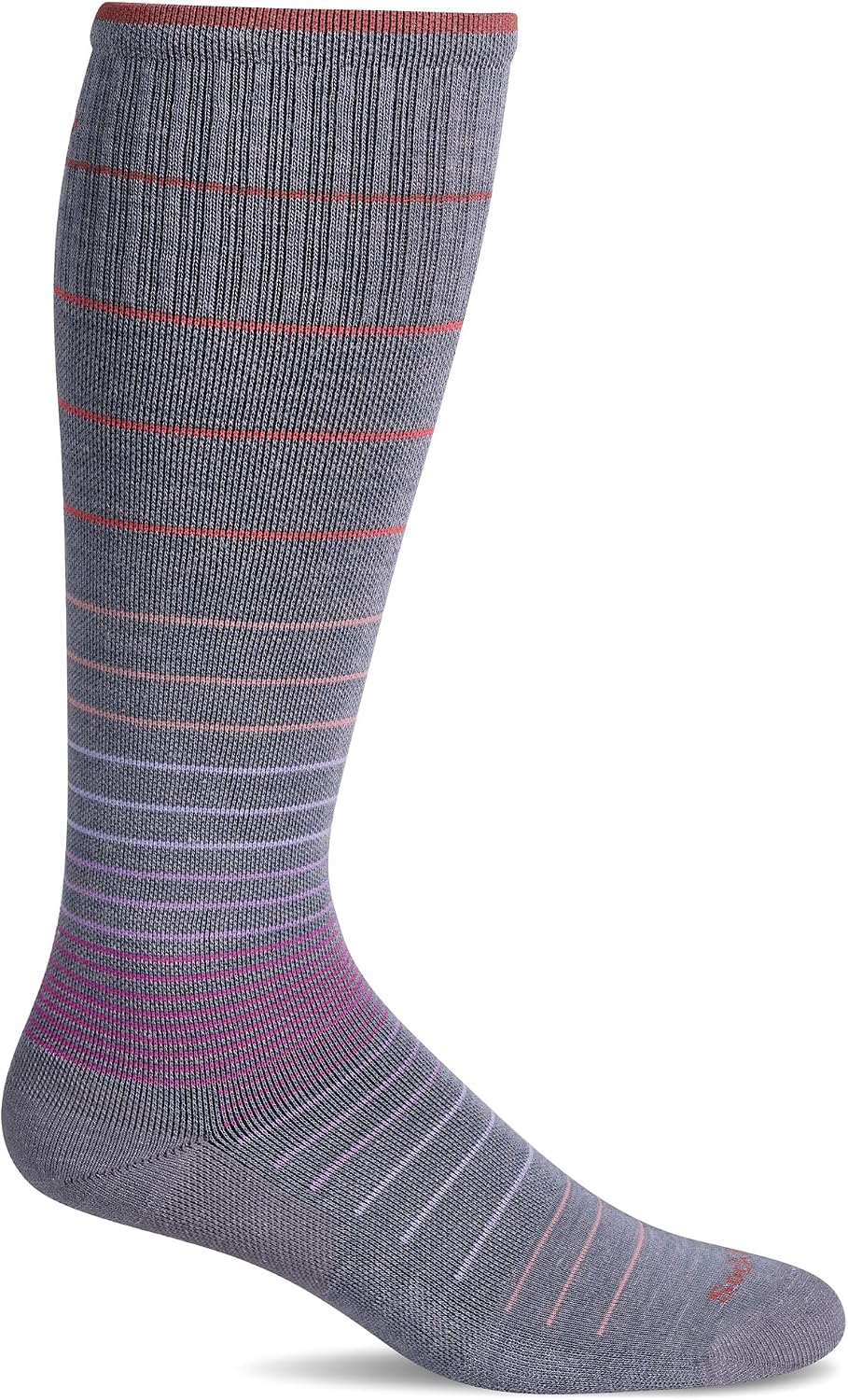
Sockwell Women's Circulator Moderate Graduated Compression
The Circulator is the pair we would suggest most women start with, and it is the best-evidenced compression sock we have found on Amazon with close to five thousand owner reviews. At 15-20 mmHg it sits at the level that actually matches how most people live: enough to make a real difference to swollen ankles and heavy legs after a long day or a flight, gentle enough that getting it on is not a wrestling match. The merino blend is what justifies the price over a nylon sock. Compression traps heat, and over a full working day merino regulates temperature and resists odour in a way synthetics simply do not. The colour range is broad enough that these do not read as medical. The trade-offs are cost and air drying, which together mean three pairs rather than one, and it is not firm enough if a clinician has specified 20-30 mmHg.
Pros
- Nearly five thousand owner reviews, the strongest record we found
- Merino handles a full day without heat or odour
- 15-20 mmHg is easy enough to don that it gets worn daily
- Broad colour range, does not look clinical
Cons
- Premium price, and three pairs is the realistic requirement
- Air dry only
- Runs narrow through the calf, with no wide option
Best for wide calves
VIM & VIGR 15-20 mmHg Cotton, Wide Calf
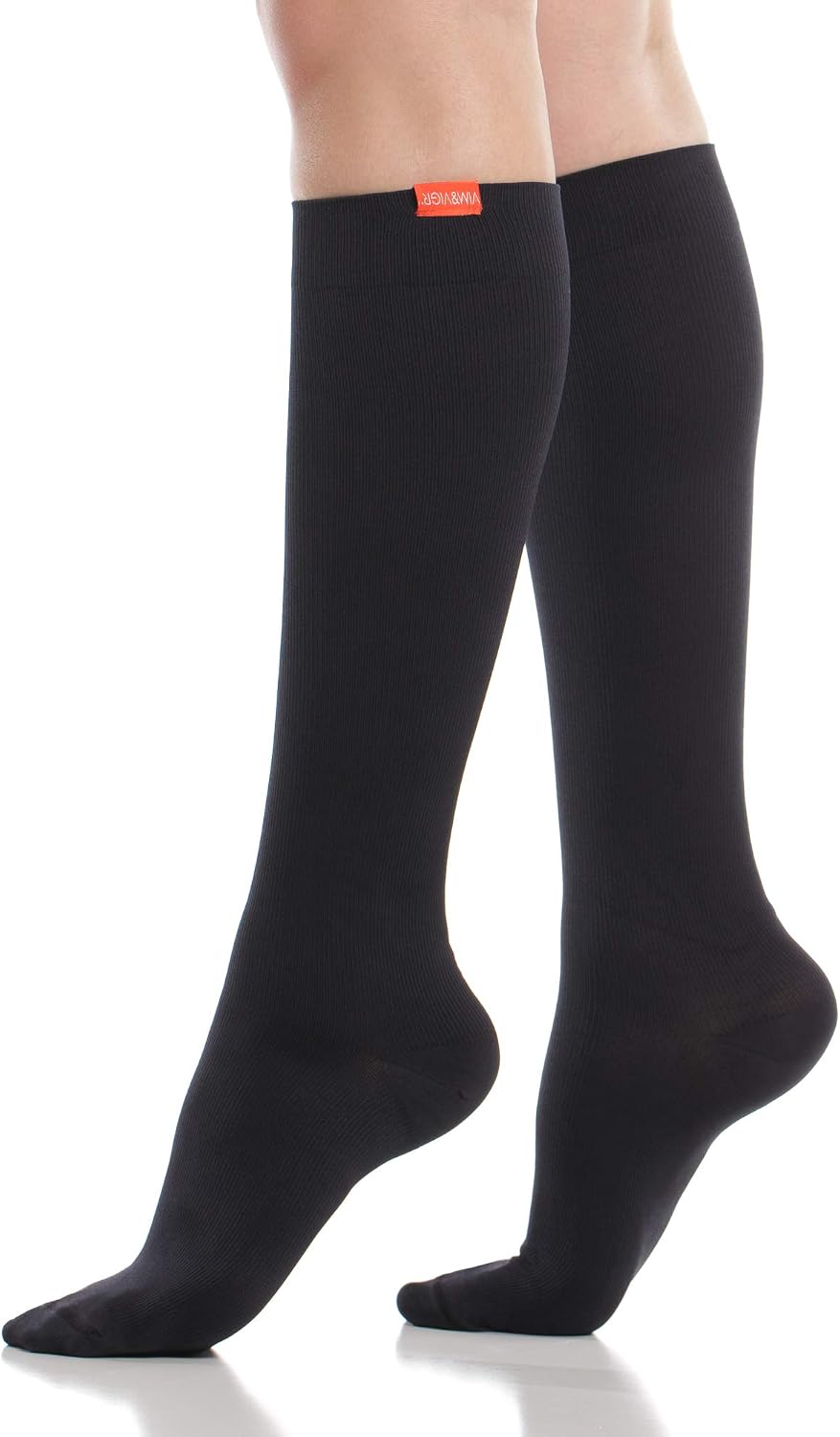
Calf circumference is the single most common reason compression socks fail women, and most brands treat wide calf as a stretched version of a standard sock rather than a designed size. VIM & VIGR build it as a genuine size class, and the difference is immediately obvious to anyone who has had a cuff leave a red trench below the knee. If you have concluded that compression socks are just uncomfortable, there is a real chance you were wearing the wrong width rather than the wrong pressure, and no amount of premium material fixes that. The cotton construction is comfortable against skin and the pattern range is the best here, which matters if they are visible. Review volume on this size variant is modest, reflecting Amazon splitting counts across sizes rather than a weak product.
Pros
- Wide calf engineered as a real size class
- Solves the most common fit complaint outright
- Best pattern and colour range here
- Comfortable cotton against skin
Cons
- This variant is 15-20 mmHg only, so no firm wide calf option
- Cotton runs warmer than merino on a long day
- Modest review count on the size variant
Most comfortable
Comrad CloudCotton Knee High
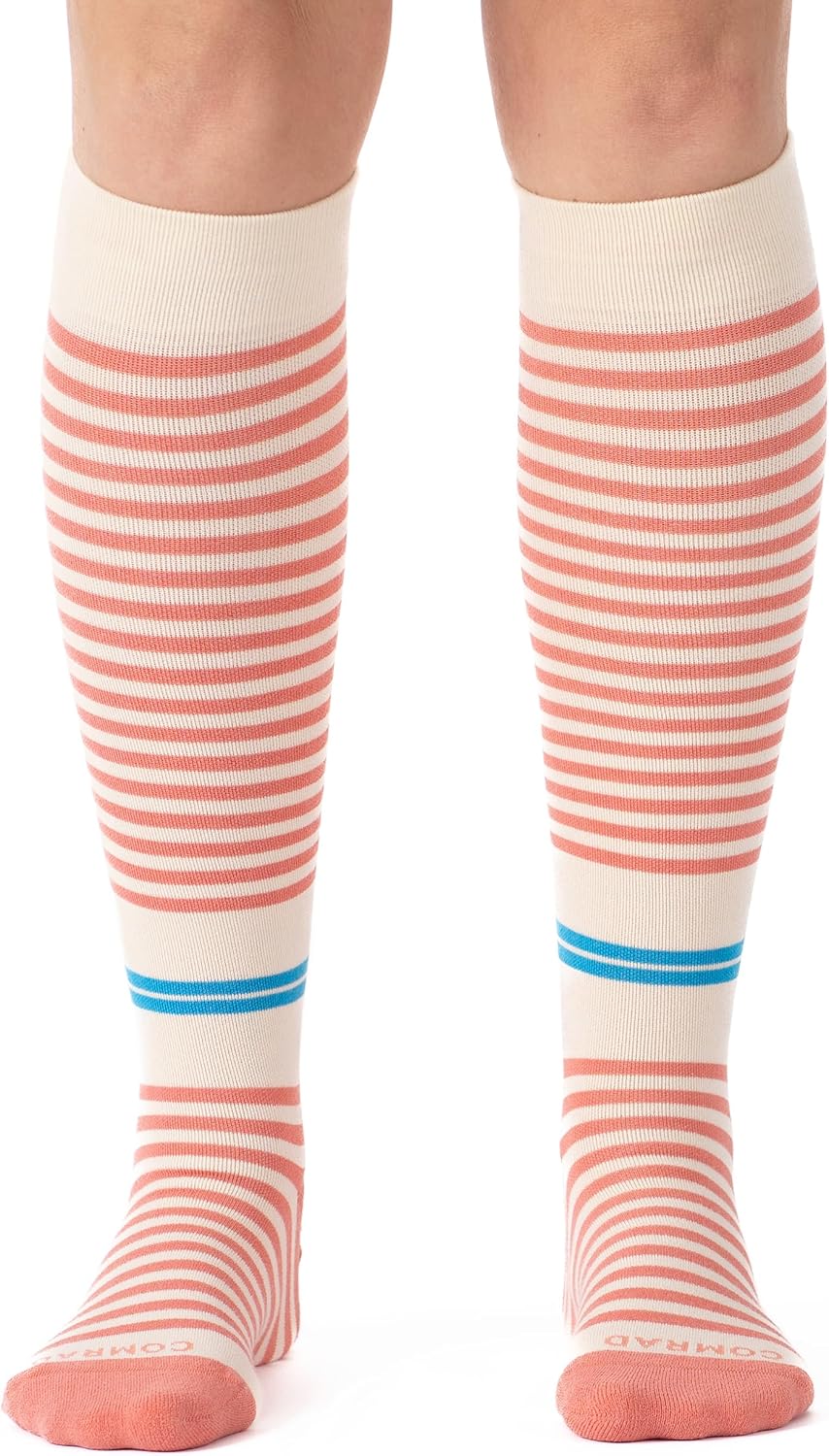
If compression socks have previously felt like medical equipment strapped to your legs, the CloudCotton is the one to try. Comrad built it on a combed cotton and tree fibre blend, and the result genuinely feels like a good everyday sock that happens to apply 15-20 mmHg. That matters more than it sounds, because the most common failure mode in this category is not ineffectiveness, it is abandonment. This is the pair most likely to survive daily wear. It is expensive for a moderate compression sock and the Amazon listing has a shorter review history than Sockwell's, so we have scored durability conservatively rather than optimistically. It is also not the answer if you need firm 20-30 mmHg.
Pros
- Feels like a normal sock rather than a device
- Cotton and tree fibre blend is genuinely pleasant
- Easy to put on before an early start
- Sold as a single pair rather than a forced multipack
Cons
- Premium price for 15-20 mmHg
- Shorter review history than the established names
- Not an option if you need firm compression
Best firm option
Sigvaris DYNAVEN Women's Calf-High 20-30 mmHg
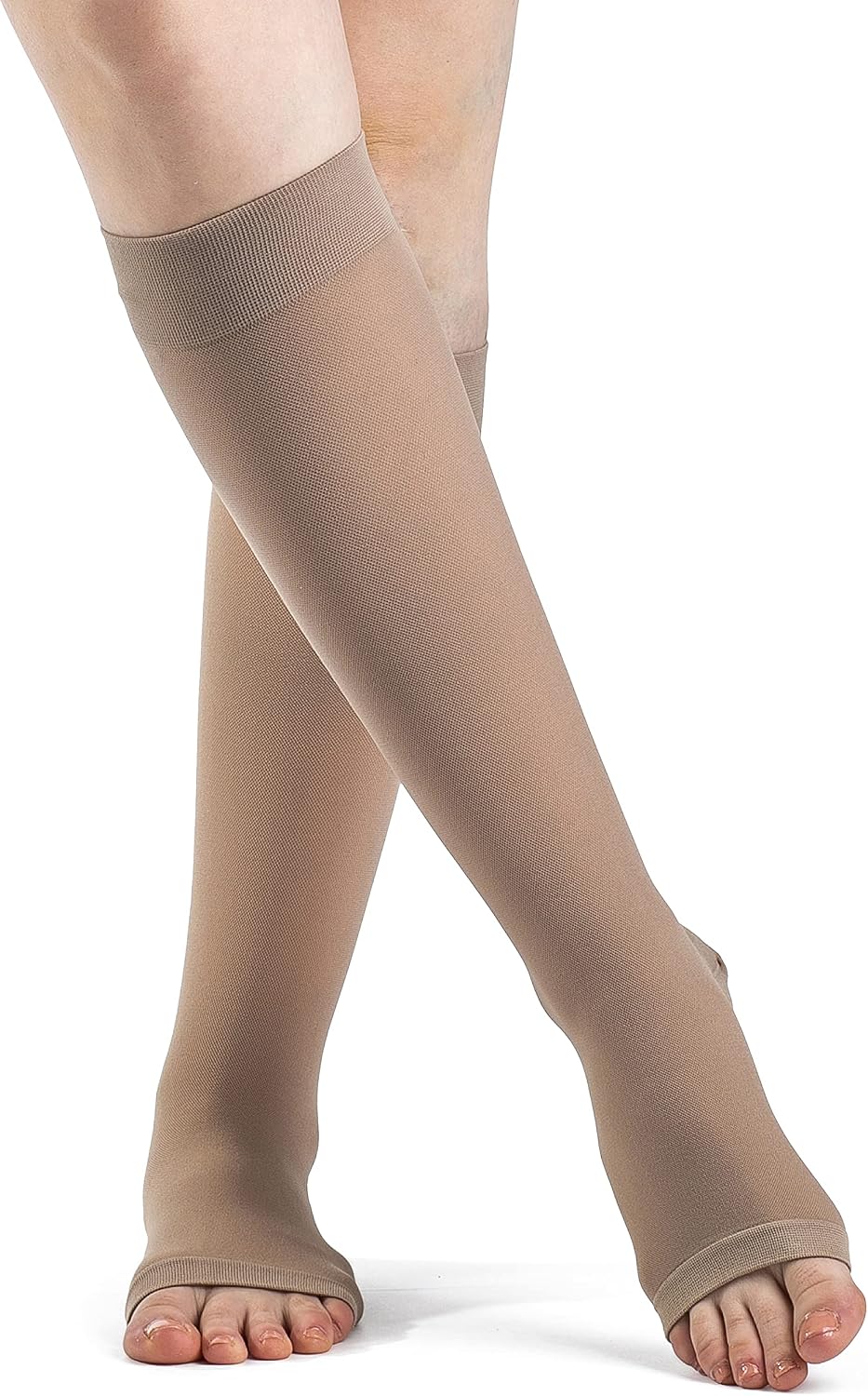
If you have been told to wear firm 20-30 mmHg rather than choosing compression for general comfort, Sigvaris is the brand on this page built for that. It comes from a medical compression background rather than a lifestyle one, and it is what a vein clinic is most likely to fit you with. The construction quality shows in how well it holds compression over months, which is exactly where cheaper firm stockings quietly degrade while still looking fine. The open toe design is the practical highlight: at this pressure, getting a stocking on is genuinely hard work, and an open toe lets you use a slip aid properly. It is the most expensive option here, the review count on this listing is modest, and it makes no attempt to look like a fashion sock. Those are all reasonable trades if the reason you are buying is clinical.
Pros
- Genuine medical compression pedigree
- Holds its rated compression well over months
- Open toe makes 20-30 mmHg far easier to don
- Well graded sizing including short and long lengths
Cons
- Most expensive option here
- Unmistakably medical in appearance
- Modest review count on this listing
Best open toe
Doc Miller Open Toe Compression Socks 15-20 mmHg
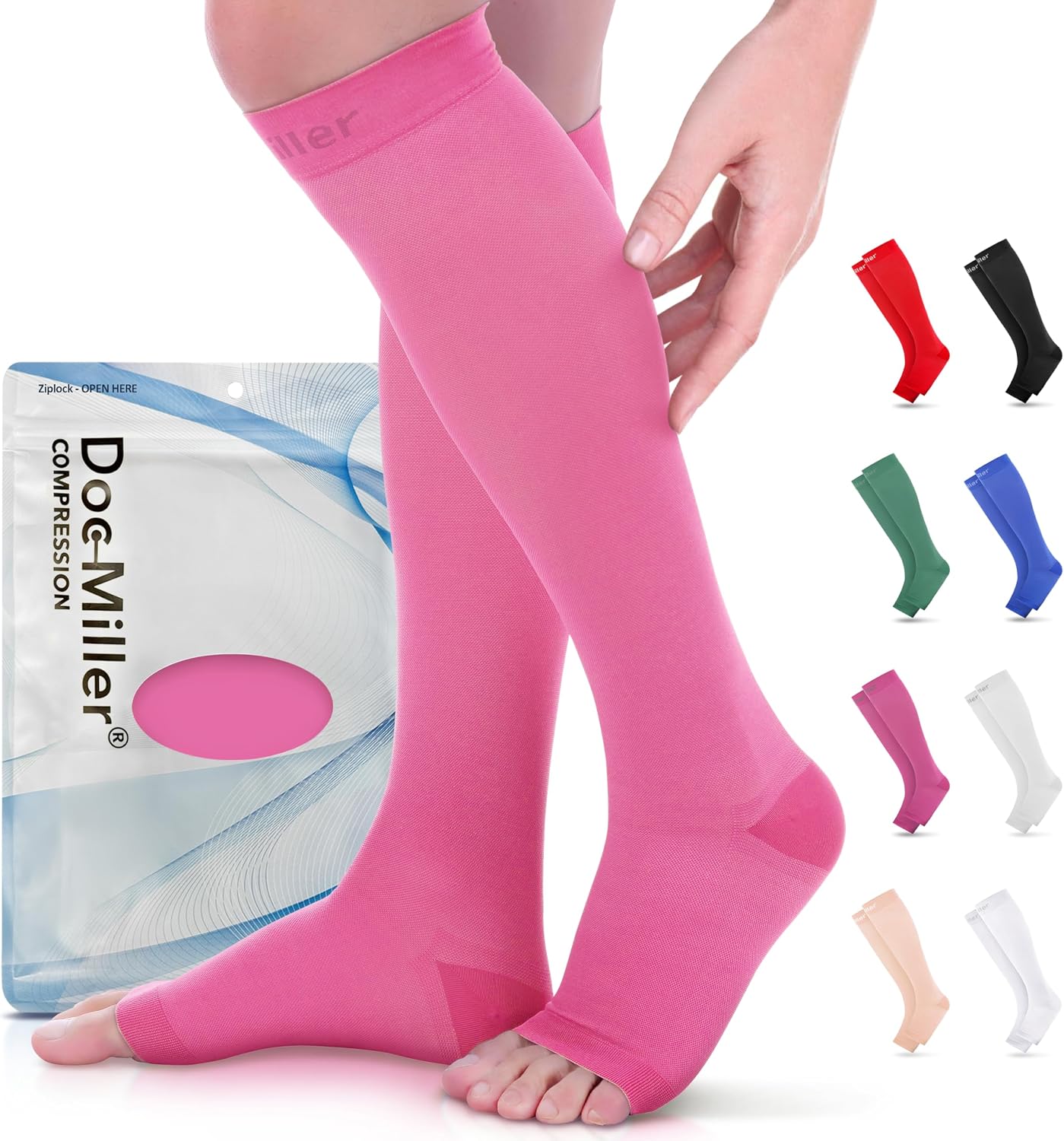
This is the pick if closed toe compression has not worked for you. The footless sleeve applies graduated 15-20 mmHg from ankle to knee and leaves the foot free, which solves three separate complaints at once: toes that ache in a compression toe box, feet that overheat, and the difficulty of getting a closed toe sock on in the first place. It also means you can wear it under your own socks or with sandals, which widens where it fits into a wardrobe. The honest limitation is that it gives your foot no support, so if your ankles and forefoot are what swell by evening, a closed toe pair does more. The nylon is basic and sizing varies between colours.
Pros
- Open toe design is far easier to get on than a closed toe
- Avoids the hot, bunched feeling around the toes entirely
- Over two hundred owner reviews at a low price
Cons
- Footless sleeve leaves the foot unsupported
- Nylon construction runs warm
- Sizing reported as inconsistent between colourways
Also worth considering
Strong, well-reviewed products that just missed our ranked list - worth a look if the picks above aren't quite right for you.
- Sockwell Women's Elevation Firm 20-30 mmHg - The firm version of our top pick, same merino blend. The natural step up if 15-20 mmHg is not controlling your swelling by evening and you want to stay with a sock that does not look clinical.
- Truform 20-30 mmHg Knee High - Plain, inexpensive and backed by over eight thousand reviews. Not remotely stylish, but if firm compression is what you need and it lives under trousers, it is the best value on this site.
- Truform 20-30 mmHg Thigh High, Dot-Top - Worth knowing about if your veins or swelling extend above the knee, which is the one situation where a knee high genuinely is not enough. Harder to keep up, and covered properly in our thigh high guide.
Frequently asked questions
What compression level should women buy?
15-20 mmHg for standing all day, travel, mild evening swelling and recovery, which covers most people. 20-30 mmHg for visible varicose veins, persistent swelling or post-surgical recovery, usually on clinical advice. Pregnancy-related swelling is worth raising with a midwife or doctor before choosing a level.
How do I know my compression sock size?
Measure ankle circumference at the narrowest point just above the ankle bone, and calf circumference at the widest point, both first thing in the morning before swelling develops. Buy on those two numbers. Shoe size is printed on most packaging because it sells better, but it is not what determines whether the sock fits.
What if compression socks cut into my calves?
That is a circumference problem, not a compression level problem, and stepping down from 20-30 to 15-20 mmHg will not fix it. You need a larger size or a dedicated wide calf model at the same pressure. Wide calf is a real engineered size class at some brands and an afterthought at others.
Are there compression socks that do not look medical?
Yes, and this is where the lifestyle brands earn their premium. VIM & VIGR and Comrad in particular make patterned and coloured socks that read as normal socks, which matters if they are visible at work or under a dress. The clinical brands are more effective per pound but unmistakably medical in appearance.
Can you wear compression socks with dresses and skirts?
Knee highs work under trousers and longer skirts easily. If you want compression that is not visible with a dress, thigh highs are the usual route, though they are harder to keep up and to put on. Patterned knee highs from the lifestyle brands are the other option, worn deliberately rather than hidden.