The Best Compression Socks for Varicose Veins (2026)
Firm 20-30 mmHg stockings from Truform, Sigvaris, JOBST and Doc Miller compared, and why the compression level itself should come from your clinician.
This is not medical advice. We are independent reviewers, not clinicians. Varicose veins are a medical condition, and the compression level appropriate for your legs should be decided by a clinician who has assessed them. There are also situations, including peripheral arterial disease and diabetic neuropathy, where compression can cause harm rather than help. Please read the section on when not to wear compression before buying anything on this page.
Compression stockings are one of the most consistently recommended conservative measures for managing varicose veins. They do not remove the veins, and nothing you can buy without a prescription does. What they do is manage the aching, heaviness and swelling that come with them, and support the leg through the day.
This page compares four 20-30 mmHg stockings that are actually buyable, and is honest about which is better at what.
Our picks at a glance
- Best overall: Truform 20-30 mmHg, the sensible default with an enormous review record
- Best clinical option: Sigvaris DYNAVEN, built to the standard a vein clinic would fit
- Best for staying up: JOBST Relief, whose silicone band solves the slipping problem
- Best budget: Doc Miller, with honest caveats about its 4.1 star rating
Relief is only one of JOBST’s lines, and the names describe fabric rather than compression strength, which is the single most common reason people buy the wrong pair. Our guide to the JOBST range decodes that before you commit.
Why 20-30 mmHg, and why you should not choose it yourself
Every stocking here states 20-30 mmHg, which is the range most commonly associated with visible varicose veins. Below that, 15-20 mmHg is generally considered everyday support rather than management of a diagnosed condition. Above it, 30-40 mmHg is used for more advanced venous disease and is normally fitted rather than bought.
We are deliberately not telling you which level you need. That is a clinical judgement based on an assessment of your legs, and the consequences of getting it wrong are not merely that the socks feel uncomfortable.
If you have been assessed and told 20-30 mmHg, this page is useful. If you have not been assessed, the more valuable next step is an appointment, not a purchase. Our mmHg guide explains the levels in more detail without prescribing one.
When compression is the wrong thing
This section matters more than the product comparisons, and most affiliate pages leave it out.
Compression works by applying external pressure that resists the outward pressure of blood in your veins. If the arterial supply into your leg is already restricted, adding external pressure can reduce it further. That is why the following are situations to discuss with a clinician before wearing compression:
- Peripheral arterial disease, or symptoms suggesting it such as leg pain when walking that eases with rest
- Diabetic neuropathy or any reduced sensation in the feet, because you may not notice a fit problem causing damage
- Certain kinds of heart failure, where shifting fluid out of the legs can add load
- Active skin infection, ulceration or dermatitis on the leg
- Known or suspected deep vein thrombosis, which needs assessment rather than a stocking
Stop wearing compression and seek advice if you get numbness, tingling, colour change in the toes, increasing pain, or skin breakdown under the stocking.
Open toe or closed toe
At 20-30 mmHg this is a bigger decision than it sounds, because donning is genuinely difficult at this level.
Open toe is much easier to get on, because you can use a slip aid and grip the fabric properly. It is also cooler and better if you have toe sensitivity or nail problems. The Sigvaris and Doc Miller are open toe.
Closed toe feels more like a normal sock and is warmer in cold weather. The Truform here is closed toe.
Neither delivers more compression. The therapeutic pressure is applied at the ankle and up the calf, not at the toes.
Fit, and the two measurements that matter
Compression stockings are sized on leg measurements. Two numbers matter:
- Ankle circumference at the narrowest point, just above the ankle bone. This is where the stated pressure is delivered, so it is the critical measurement.
- Calf circumference at the widest point.
For knee highs you also want floor-to-knee-bend length, because several brands here offer short and long variants, and a stocking that bunches behind the knee creates a pressure point in exactly the wrong place.
Measure first thing in the morning, before swelling develops. Measuring a swollen leg in the evening gives you a stocking that is too loose the next morning and does not deliver its rated compression.
Putting them on
A 20-30 mmHg stocking is hard work, and most people who abandon compression do so because of donning rather than because of how it feels once on.
Practical things that help: put them on before getting out of bed, or at least before standing for long. Wear rubber washing-up gloves, which give far more grip than bare hands and reduce the risk of laddering the fabric with fingernails. Turn the stocking inside out down to the heel, position the heel first, then roll it up rather than pulling from the top. A metal or fabric donning aid costs little and makes an enormous difference, particularly with an open toe stocking. Our step-by-step guide to putting on compression socks walks through the heel-first method in more detail, and it is worth reading once before your first pair arrives.
They wear out, and that matters more here
Elastane degrades with washing and stretching, and most manufacturers put the useful life of a compression stocking at three to six months of regular wear.
For a lifestyle sock, a fading pair is a minor annoyance. For managing a diagnosed condition, a stocking delivering meaningfully less than its rated pressure is not doing the job you are relying on it for, while feeling and looking fine.
Keep at least two or three pairs in rotation, replace them on a schedule rather than when they visibly fail, wash them cool without fabric softener, and air dry. This is a real running cost and it is the honest argument for including a budget option on this list.
If your legs ache but you have no diagnosis
Plenty of people arrive at a page like this because their legs feel heavy and their ankles swell after work, without any diagnosis of vein disease.
If that is you, 20-30 mmHg is probably a heavier tool than you need, and the more useful pages are our guide to compression socks for long shifts and our general compression sock roundup, both of which centre on the gentler 15-20 mmHg level that suits everyday standing. It is also worth reading what the evidence actually supports before spending anything, because the case is much stronger for some uses than others.
It is also worth remembering that swelling and aching after standing all day can come from the floor and the footwear as much as from circulation. An anti-fatigue mat and better shoes address a different part of the same problem.
And if the aching is persistent, worsening, or affects one leg noticeably more than the other, that is worth a clinical opinion rather than a purchase.
How we test
Every pick is scored on the same five criteria and cross-checked against real owner feedback - so the ranking reflects how a product holds up over a full shift, not its spec sheet.
Support
Whether graduated compression actually matches its stated mmHg rating, or, for mats and insoles, how much load it takes off your legs.
Comfort
All-day wearability: no bite at the cuff, no hotspots, breathable enough for a full shift.
Durability
Whether it holds compression or loft after repeated washing and months of daily use.
Fit
Size range, calf-width options, and how honest the sizing chart is against real owner reports.
Value
What you get for the price, including cost per wear once durability is accounted for.
Best overall
Truform 20-30 mmHg Knee High
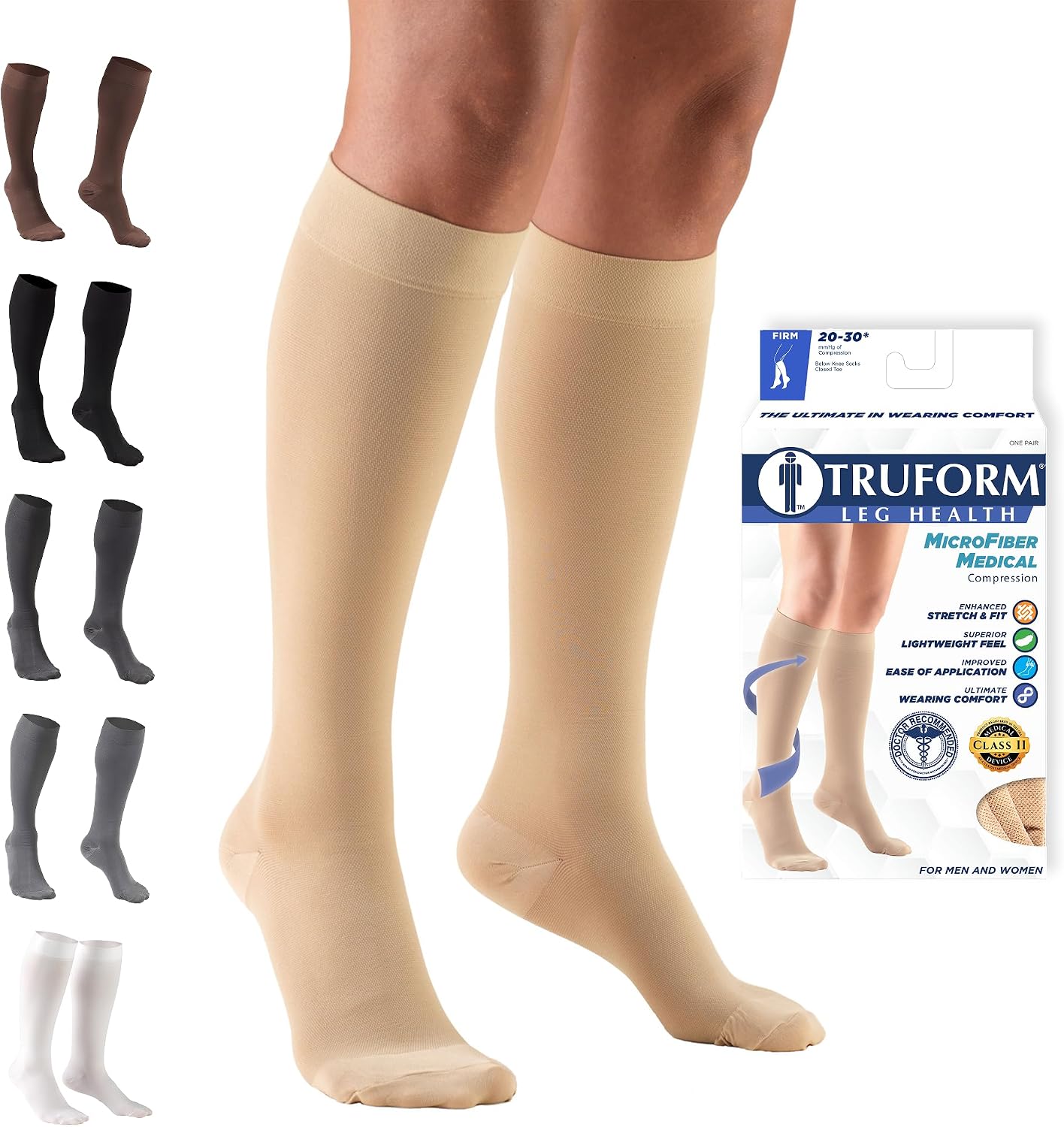
Truform is the sensible default at this compression level, and the review base is the reason. With over eight thousand owner reviews it has a longer and more consistent record than anything else here by a wide margin, which matters more in medical compression than in lifestyle socks, because consistency between pairs is part of what you are buying. It is a plain, unglamorous stocking with a straightforward closed toe knee-high construction and a stated 20-30 mmHg, and it costs a fraction of the specialist brands. Owners rate it well on how evenly the compression is applied through the calf. What you give up is refinement: it is beige-and-black medical looking, the fabric is heavier than the premium options, and it runs warm. If you need firm compression that works under trousers and you are not paying for appearance, start here.
Pros
- Over eight thousand owner reviews, by far the strongest record here
- Consistent, even compression through the calf
- Inexpensive enough to keep several pairs in rotation
- Widely available in a full size and length range
Cons
- Distinctly medical in appearance
- Heavier fabric that runs warm
- Closed toe makes it harder to don than open toe alternatives
Best clinical option
Sigvaris DYNAVEN Women's Calf-High 20-30 mmHg
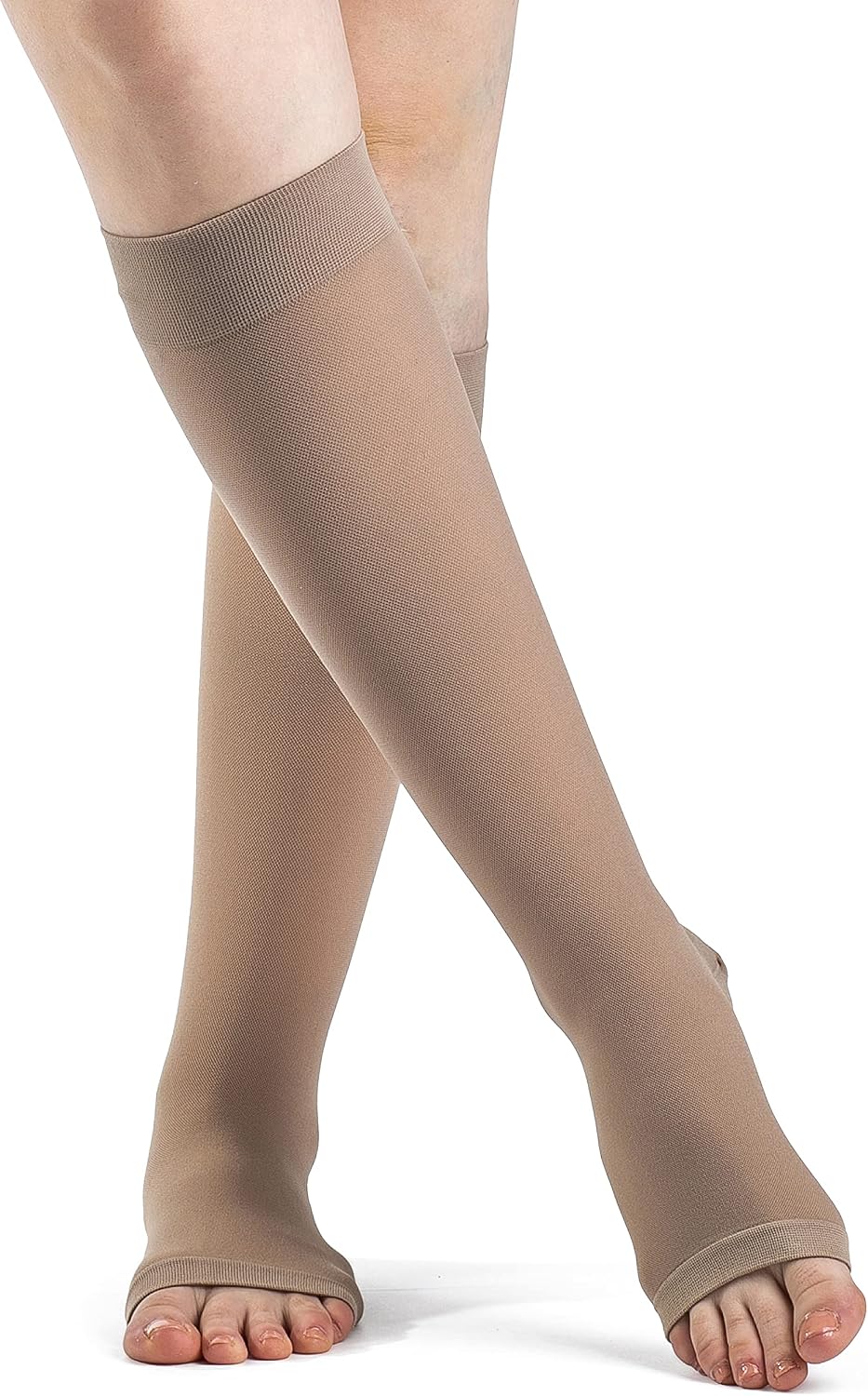
Sigvaris comes from a medical compression background rather than a lifestyle one, and the DYNAVEN line is what you are most likely to be handed if a vein clinic fits you. That pedigree shows in construction quality and in how well the compression holds over months, which is where cheaper stockings quietly degrade. The open toe design is the practical highlight: at 20-30 mmHg, donning is genuinely difficult, and an open toe lets you use a slip aid and get real purchase on the fabric. It is the most expensive option here and the review count on this listing is modest, but the brand's clinical track record is long and independent of Amazon. If you have been formally assessed and want a stocking built to that standard, this is it.
Pros
- Genuine medical compression pedigree
- Open toe makes 20-30 mmHg far easier to put on
- Holds its compression well over months of wear
- Well graded sizing including short and long lengths
Cons
- Most expensive option here
- Modest review count on this specific listing
- Open toe is not to everyone's taste in cold weather
Best for staying up
JOBST Relief Knee High 20-30 mmHg
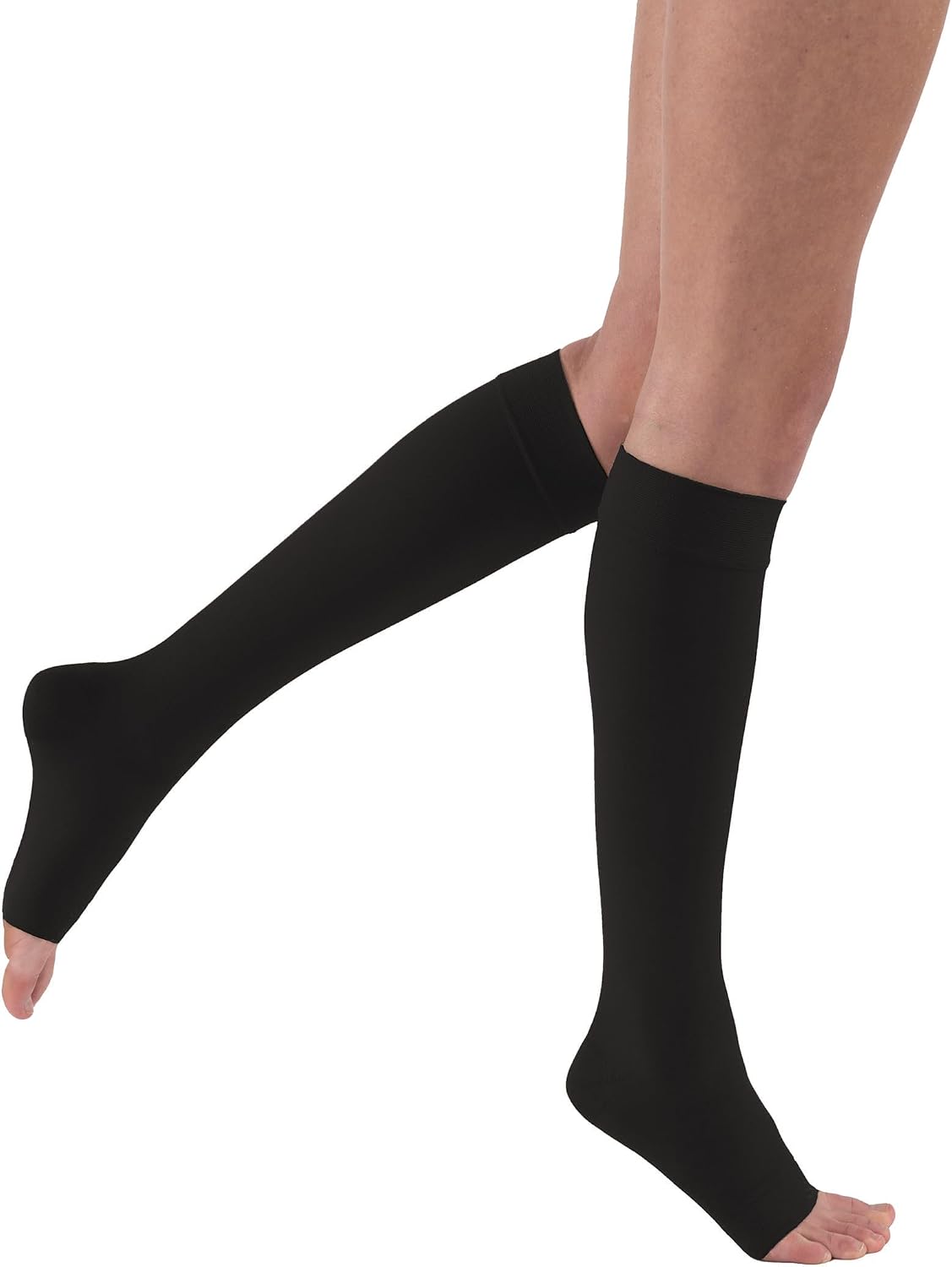
JOBST is one of the names clinicians actually recognise, and Relief is its accessible tier: proper medical construction without the price of the premium lines. The feature worth singling out is the silicone dot band at the top. A very common complaint at 20-30 mmHg is a stocking that either slides down through the day or grips so hard it leaves a trench, and the dot band is a genuinely effective middle path, holding position without needing the cuff to be brutally tight. The open toe version is the easier one to don. The Amazon listing we verified is a size variant with a small review count, which reflects how Amazon splits counts across sizes rather than the product's standing, and JOBST's reputation rests on decades of clinical use rather than on marketplace reviews.
Pros
- Silicone dot band stops slipping without an over-tight cuff
- Clinically recognised brand at an accessible price
- Open toe option is much easier to get on
- Good length and size grading
Cons
- Small review count on the specific size variant
- Silicone band can irritate very sensitive skin
- Plain, medical appearance
Best budget option
Doc Miller Open Toe Compression Socks 20-30 mmHg
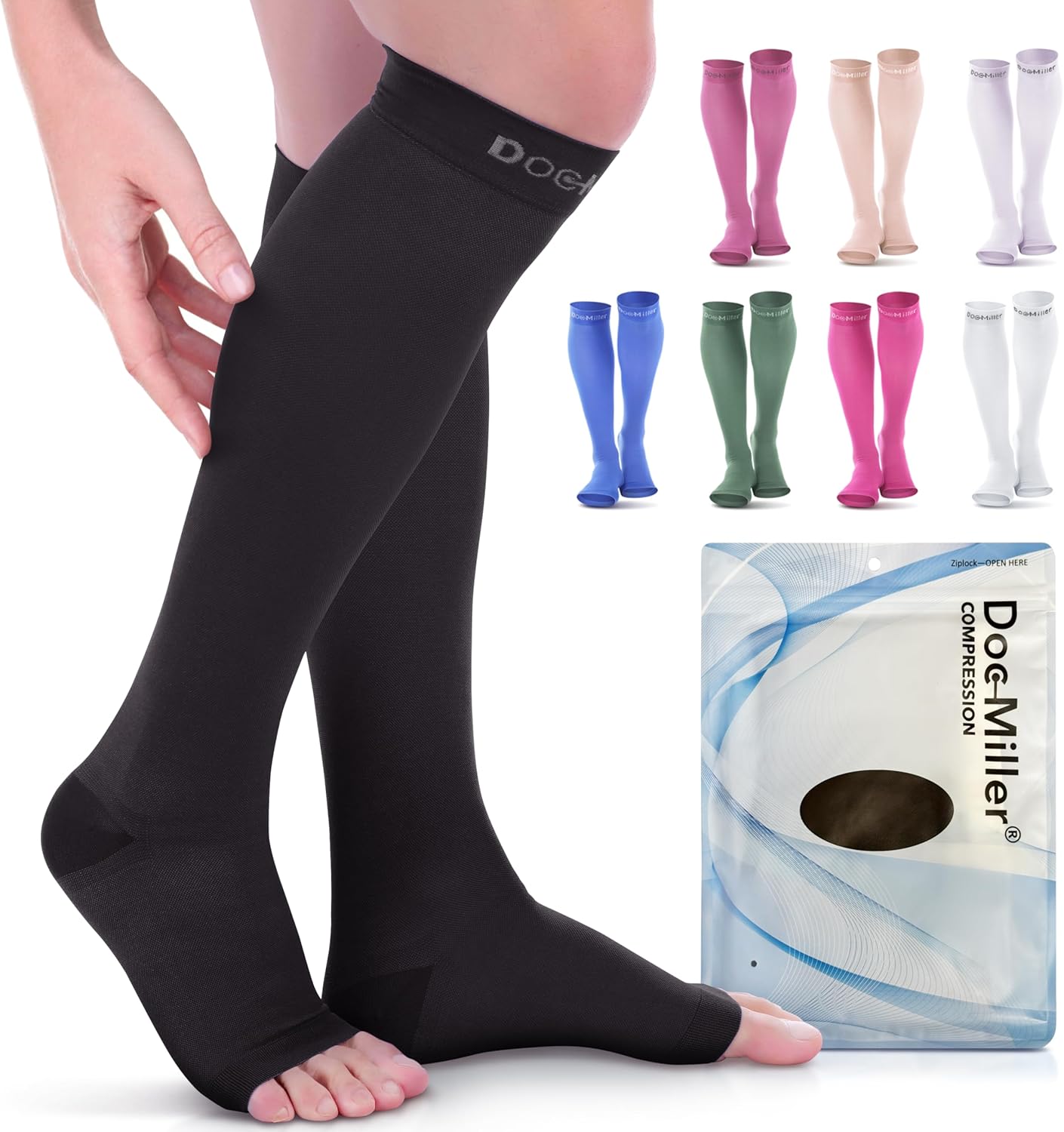
Doc Miller is the value pick, and given that firm compression stockings are a long-term purchase rather than a one-off, cost per month is a fair thing to optimise. It offers a stated 20-30 mmHg in an open toe knee-high, with a footless sleeve design that some people much prefer because it avoids the hot, bunched feeling around the toes entirely. With over four hundred reviews it is a known quantity. We should be straight about the rating: it sits at 4.1 stars, the lowest here, and the recurring themes in critical reviews are inconsistent sizing between colours and compression that softens sooner than the specialist brands. At this price, replacing them more often is a workable answer, but do not expect Sigvaris longevity.
Pros
- Firm 20-30 mmHg at the lowest price here
- Open toe sleeve avoids heat and bunching at the toes
- Over four hundred owner reviews
Cons
- Rated 4.1 stars, the lowest on this list
- Sizing reported as inconsistent between colourways
- Compression softens sooner than the specialist brands
Best if veins extend above the knee
Beister Thigh High Compression Stockings 20-30 mmHg
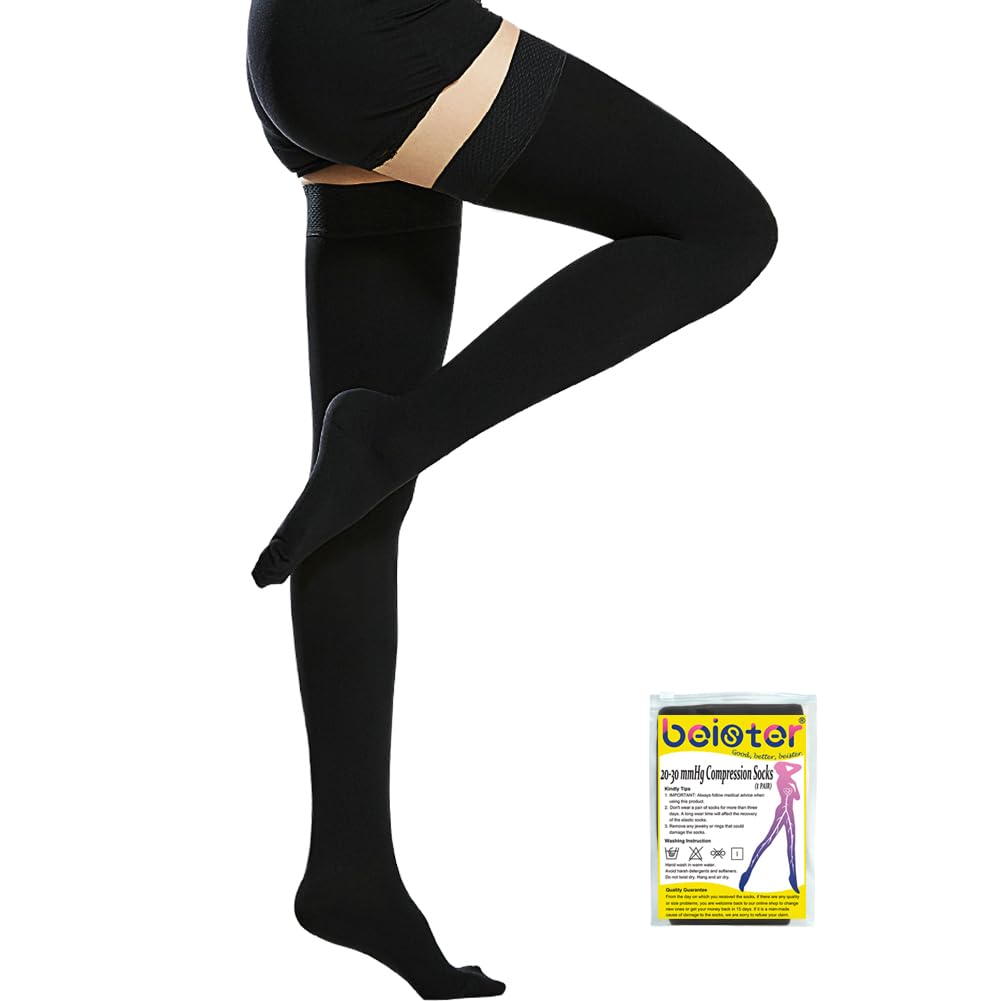
Every other pick here is knee high, which is right for most people because that is where venous pressure is highest and where varicose veins usually sit. If yours extend into the thigh, none of them cover the affected area. This is the affordable thigh high option, a stated 20-30 mmHg closed toe stocking with a silicone band, backed by over a thousand owner reviews. It is a genuinely different form factor rather than a fifth version of the same thing. Be realistic about the trade: thigh highs are harder to put on, harder to keep up, and this one is not built to Sigvaris or JOBST standards, with compression that softens sooner. Do not buy the longer length unless you actually need it, and if you do, our dedicated thigh high guide compares the options properly.
Pros
- Covers thigh veins that a knee high cannot reach
- Silicone band helps it stay up
- Over a thousand owner reviews at a low price
Cons
- Harder to don and to keep up than a knee high
- Compression softens sooner than the specialist brands
- Most people do not need thigh coverage
Also worth considering
Strong, well-reviewed products that just missed our ranked list - worth a look if the picks above aren't quite right for you.
- Sockwell Women's Elevation Firm 20-30 mmHg - A merino option at the same firm compression level. Not a clinical brand, but far more comfortable across a long day than any of the medical stockings here, and worth considering if you need 20-30 mmHg and will be wearing it at work.
- Sockwell Men's Elevation Firm 20-30 mmHg - The men's equivalent, same merino construction and the same firm compression, with a longer review history than most medical listings on Amazon.
- Run Forever 20-30 mmHg Knee High - The cheapest way to build a rotation of firm compression. Basic nylon construction, but if cost is the barrier to wearing compression consistently, consistency matters more than materials.
Frequently asked questions
What compression level is used for varicose veins?
20-30 mmHg is the level most commonly associated with visible varicose veins, and 30-40 mmHg is used for more advanced venous disease. That said, the level should be set by the clinician assessing your legs rather than chosen from a product page. Every sock on this list states 20-30 mmHg.
Do compression socks get rid of varicose veins?
No, and any page telling you otherwise is selling something. Compression is used to manage symptoms such as aching, heaviness and swelling, and to slow progression. It does not remove existing varicose veins. Procedures that treat the veins themselves are a separate conversation with a clinician.
Open toe or closed toe?
Open toe is considerably easier to put on, which matters a lot at 20-30 mmHg, and it suits people who find a closed toe hot or who have toe sensitivity. Closed toe is warmer, feels more like a normal sock, and is the usual choice in cold weather. Neither is more effective; the compression happens at the ankle and calf, not the toes.
When should I put compression stockings on?
First thing in the morning, before you have been upright long enough for swelling to develop. Putting them on over an already swollen leg is both much harder and less effective. They generally come off at bedtime unless a clinician has advised otherwise.
Is there anyone who should not wear compression socks?
Yes. Compression can be harmful rather than helpful if you have peripheral arterial disease, certain kinds of heart failure, an active skin infection on the leg, or reduced sensation from diabetic neuropathy that stops you noticing a fit problem. These are exactly the situations where a clinician rather than a review site should be making the call.