The Best Compression Socks (2026): Tested Across Brands
Compression socks from Sockwell, Comrad, Vim & Vigr and Run Forever compared, including wide-calf options and both 15-20 and 20-30 mmHg.
Most compression sock guides are published by a compression sock brand. That is not a conspiracy, it is just how the category works: Sockwell, Comrad, Vim & Vigr, Bombas and Pro Compression all run content operations, and every one of those guides concludes that their own socks are the answer.
We do not sell socks. This roundup compares four pairs from four different brands on the same five criteria, and says plainly where each one loses.
Our picks at a glance
- Best overall: Sockwell Women’s Elevation Firm, for merino comfort at a genuinely firm 20-30 mmHg
- Most comfortable: Comrad CloudCotton, the pair most likely to actually get worn
- Best for wide calves: VIM & VIGR Wide Calf, which solves the most common fit failure
- Best value: Run Forever 20-30 mmHg, firm compression without the premium price
How we picked
We only considered socks that are sold as a single pair and that have a working Amazon buy box. Both filters removed more candidates than we expected. Compression socks are overwhelmingly sold in three and six packs, which is the wrong link for someone who wants to try one pair, and several well-known premium brands sell almost exclusively direct rather than through Amazon, leaving thin listings behind.
We also applied a quality floor of roughly 4.2 stars with a meaningful review count. That eliminated several widely recommended budget brands sitting at 4.1.
Then we scored on support, comfort, durability, fit and value. Fit carries more weight here than in most categories, because calf circumference is the number one reason a pair gets abandoned.
Choosing a compression level
Everything below assumes you have settled on a level. If you have not, read our mmHg guide first, because it is the decision that matters most. And if you are not yet convinced any of this is worth buying, we went through what the evidence actually shows separately, including where it is weaker than the marketing suggests.
The short version:
- 15-20 mmHg for standing shifts, travel, mild evening swelling and recovery. This is the right answer for most people.
- 20-30 mmHg for visible varicose veins, persistent swelling and post-surgical recovery, usually on clinical advice.
- 30-40 mmHg and above is prescription territory and should not be chosen from a review site.
Two of our picks are 15-20 and two are 20-30, so the list covers both. If you are specifically dealing with visible varicose veins, that page is the better starting point than this one: the whole field there is firm 20-30 mmHg, and the criteria that separate a good stocking shift entirely.
Merino or nylon
This is the second decision, and it splits mostly on how long you wear them.
Merino, as in the Sockwell, is worth the money for full-day wear. It regulates temperature and resists odour in a way synthetics do not, which is the difference between a sock you tolerate and one you forget you have on. It costs more and needs air drying. Sockwell runs several merino models at different compression levels and they are not interchangeable, so if that is the direction you are heading we compare the Sockwell range model by model.
Cotton blends, as in the Comrad and Vim & Vigr, sit in the middle: comfortable against skin, breathable, less technical.
Nylon, as in the Run Forever, is cheapest and dries fastest, and runs hottest. Fine for a flight or a gym session, less pleasant across a twelve hour shift.
The fit problem nobody warns you about
If you take one thing from this page, make it this: compression socks are sized on your leg, not your foot.
Many brands print a shoe size range because it sells better, but the measurement that determines whether the sock works is calf circumference, with ankle circumference second. Get it wrong and a perfectly good 15-20 mmHg sock will feel like it is cutting into your leg, and you will wrongly conclude that you need a lower compression level.
Measure first thing in the morning, before any swelling develops. If your calf measurement sits near the top of a size band, size up or go to a wide-calf model. That is exactly why the Vim & Vigr wide calf is on this list.
They wear out faster than you think
Compression comes from elastane, and elastane degrades with every wash and every stretch. Manufacturers put the useful life at roughly three to six months of regular wear.
This is the most commonly missed fact about compression socks, and it explains a lot of disappointed reviews. A two year old pair that still looks fine may be delivering half its printed pressure. If you depend on them, keep two or three pairs in rotation and replace them on a schedule rather than when they visibly fail.
Wash cool, skip the fabric softener, which coats and degrades the fibres, and air dry. This is also the practical argument for the Run Forever: if socks are a consumable, buying consumable-priced ones is a defensible strategy.
If you stand all day, socks are only half of it
Compression addresses blood pooling, and why your feet and legs hurt after standing all day explains that mechanism properly. It does nothing about the surface under your feet, which is the other half of why standing on concrete for eight hours hurts. If that is your situation, pair these with a proper anti-fatigue mat, which does the part compression cannot.
And if you are choosing specifically between two of the brands here, we ran Sockwell against Vim & Vigr directly rather than reviewing each in isolation. If you want the clinical end of the market instead, JOBST is the name most often recommended by clinicians, and it is in the also-worth-considering list below. Its line names describe fabric rather than strength, which trips up most buyers.
Sizing, styling and who this page is for
The picks above are chosen on specification rather than on who the packaging is aimed at, and most of them are available in more than one cut. If you would rather see the field narrowed that way, our men’s roundup accounts for the calf sizing and styling differences in the men’s lines; this page covers the women’s and unisex field.
A note on scope
We are independent reviewers, not clinicians. This page describes how these socks are specified, made and sold, and how they compare against each other. If you have diabetes, peripheral arterial disease, lymphoedema, or a diagnosed venous condition, the compression level should come from a clinician rather than from a roundup.
How we test
Every pick is scored on the same five criteria and cross-checked against real owner feedback - so the ranking reflects how a product holds up over a full shift, not its spec sheet.
Support
Whether graduated compression actually matches its stated mmHg rating, or, for mats and insoles, how much load it takes off your legs.
Comfort
All-day wearability: no bite at the cuff, no hotspots, breathable enough for a full shift.
Durability
Whether it holds compression or loft after repeated washing and months of daily use.
Fit
Size range, calf-width options, and how honest the sizing chart is against real owner reports.
Value
What you get for the price, including cost per wear once durability is accounted for.
Best overall
Sockwell Women's Elevation Firm Graduated Compression
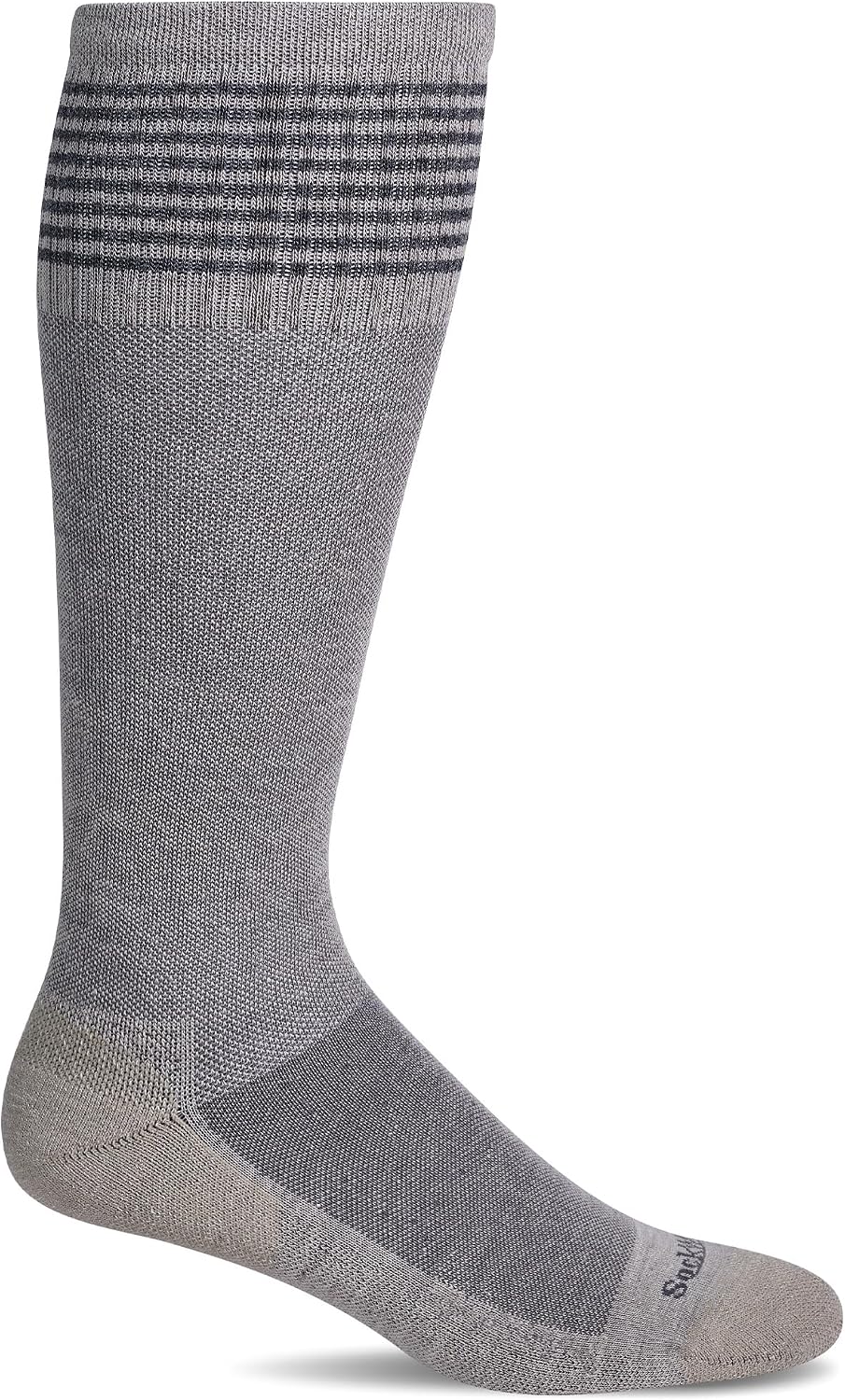
Sockwell's Elevation is the pair we would point most people toward if they want firm 20-30 mmHg compression they can tolerate for a full day. The merino blend is the reason. Nylon compression socks at this level get hot and start to smell by hour eight, and merino simply does not, which turns a sock you endure into one you forget about. The graduation is well executed, with a genuinely firm ankle that eases properly up the calf rather than clamping at the top. It has one of the longest and most credible review histories of any compression sock on Amazon, which matters in a category full of newly listed products with a handful of reviews. It is not cheap, and the merino needs air drying, but per month of useful life it works out better than replacing budget pairs constantly.
Pros
- Merino blend regulates temperature and resists odour over long shifts
- Firm 20-30 mmHg with a well-executed gradient
- Long, credible owner review history
- Holds its compression better than budget nylon pairs
Cons
- Expensive compared with nylon alternatives
- Needs air drying, so you want more than one pair
- 20-30 mmHg takes effort to put on
Most comfortable
Comrad CloudCotton Knee High
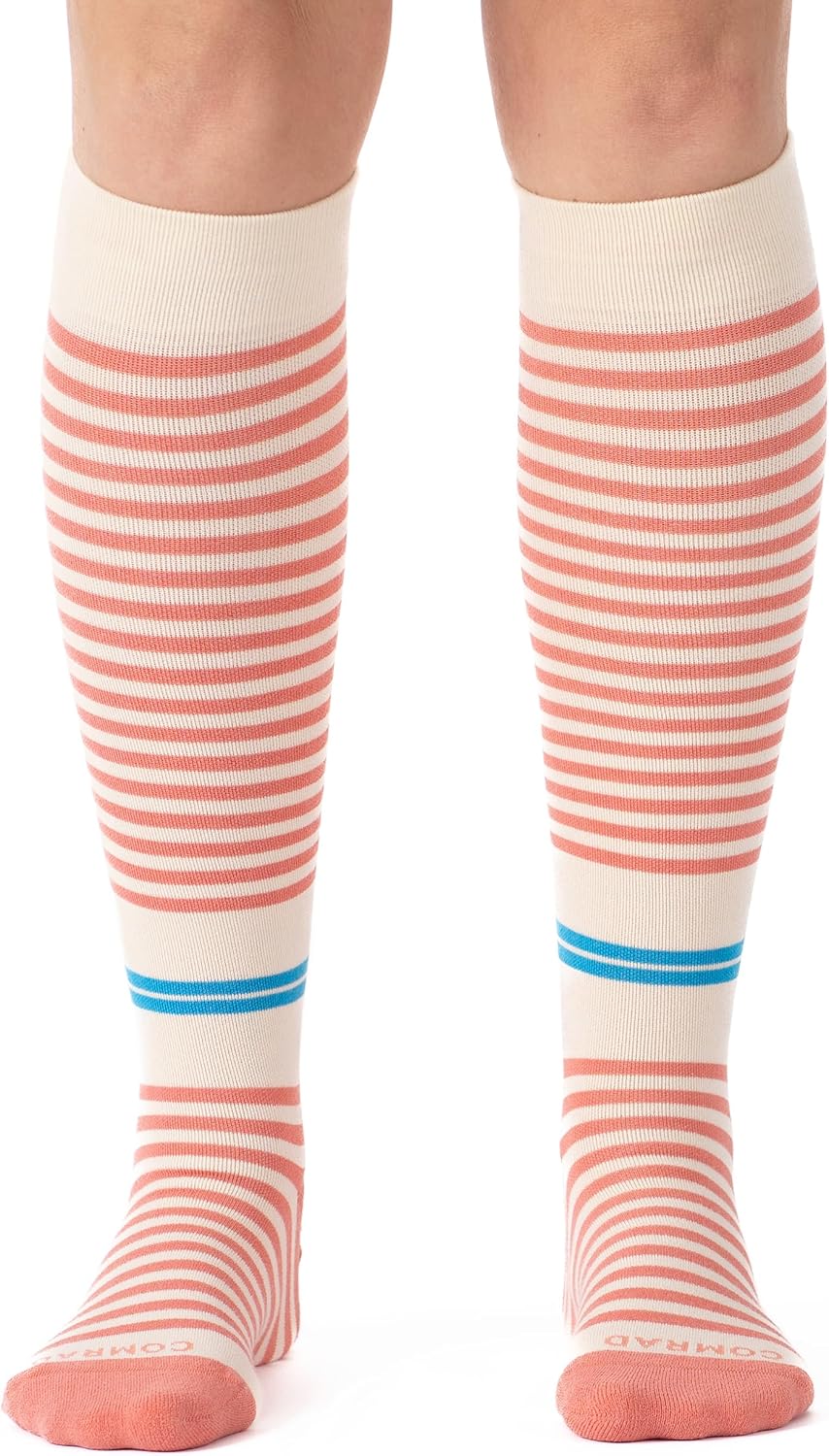
If previous compression socks have put you off because they felt like medical equipment, the CloudCotton is the one to try. Comrad built this around a combed cotton and tree fibre blend, and the result is a sock that feels like a good everyday sock that happens to apply 15-20 mmHg. That matters more than it sounds: the most common reason compression socks fail is that people stop wearing them. This is the pair most likely to survive that test. At 15-20 mmHg it is squarely in everyday territory rather than medical, so it is the right pick for standing shifts, travel and mild evening swelling, and the wrong pick if you have been told to wear firm compression. The Amazon listing has a shorter review history than Sockwell's, so we have scored durability conservatively.
Pros
- Genuinely comfortable, feels like a normal sock rather than a device
- Cotton blend is pleasant against skin and breathes well
- 15-20 mmHg is easy to get on, so it gets worn
- Sold as a single pair rather than forcing a multipack
Cons
- Premium price for an everyday compression level
- Shorter Amazon review history than the established names
- Not firm enough if you need 20-30 mmHg
Best for wide calves
VIM & VIGR 15-20 mmHg Cotton, Wide Calf
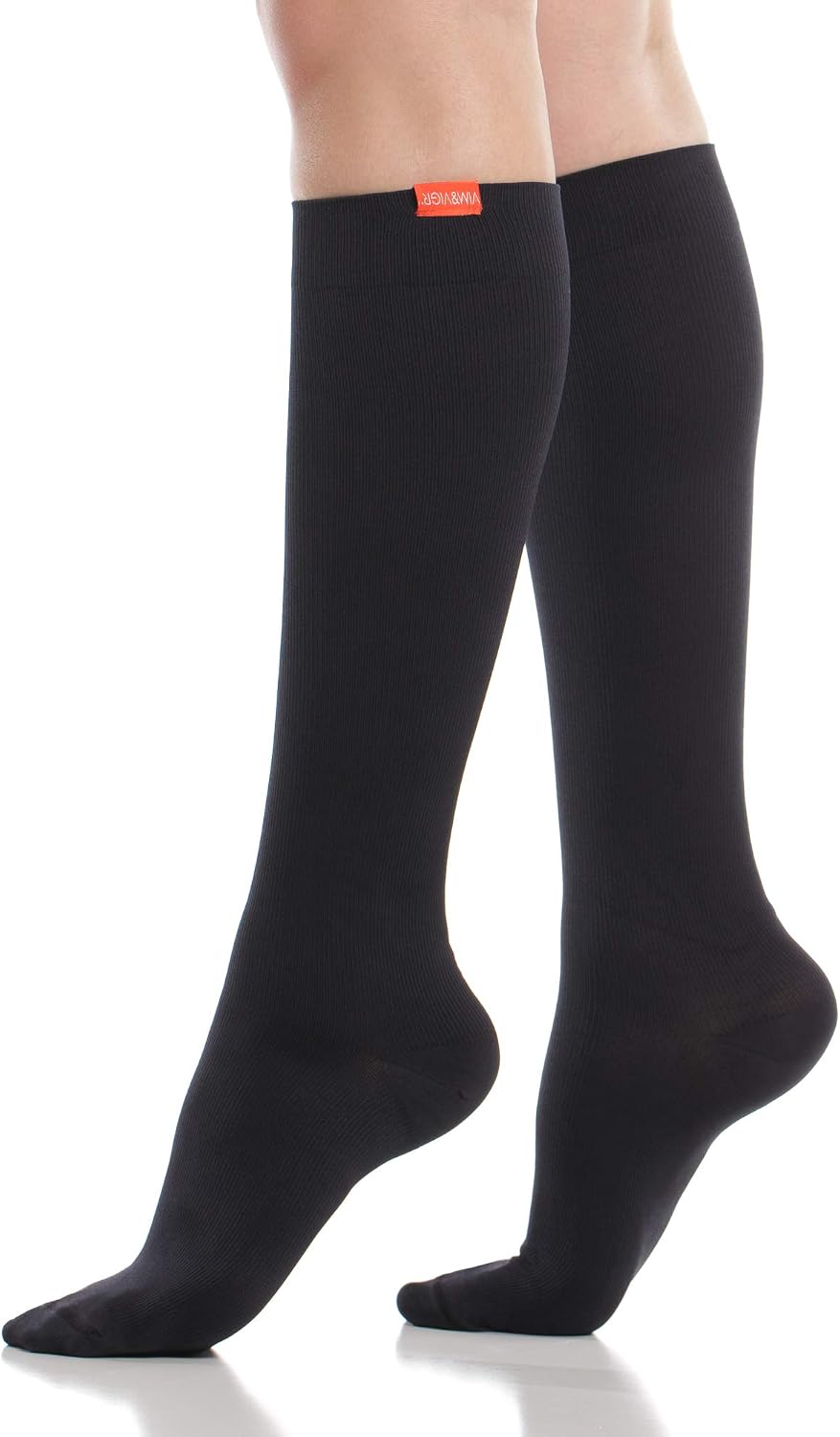
Calf circumference is the single most common reason compression socks fail people, and most brands treat wide calf as an afterthought or ignore it entirely. Vim & Vigr build it as a proper size class rather than stretching a standard sock, which is the difference between a sock that fits and one that leaves a red trench below the knee. If you have muscular or fuller calves and have concluded that compression socks are just uncomfortable, there is a good chance you were wearing the wrong width rather than the wrong pressure. The cotton construction is comfortable for all-day wear, and 15-20 mmHg is the sensible everyday level. Review volume on this specific listing is modest, which reflects it being a size variant rather than a reflection on the product.
Pros
- Wide calf built as a real size class, not a stretched standard sock
- Comfortable cotton construction for long wear
- 15-20 mmHg suits everyday standing and travel
- Genuinely solves the most common compression sock complaint
Cons
- Modest review count on this size variant
- Pricey for 15-20 mmHg
Best value
Run Forever Compression Socks 20-30 mmHg
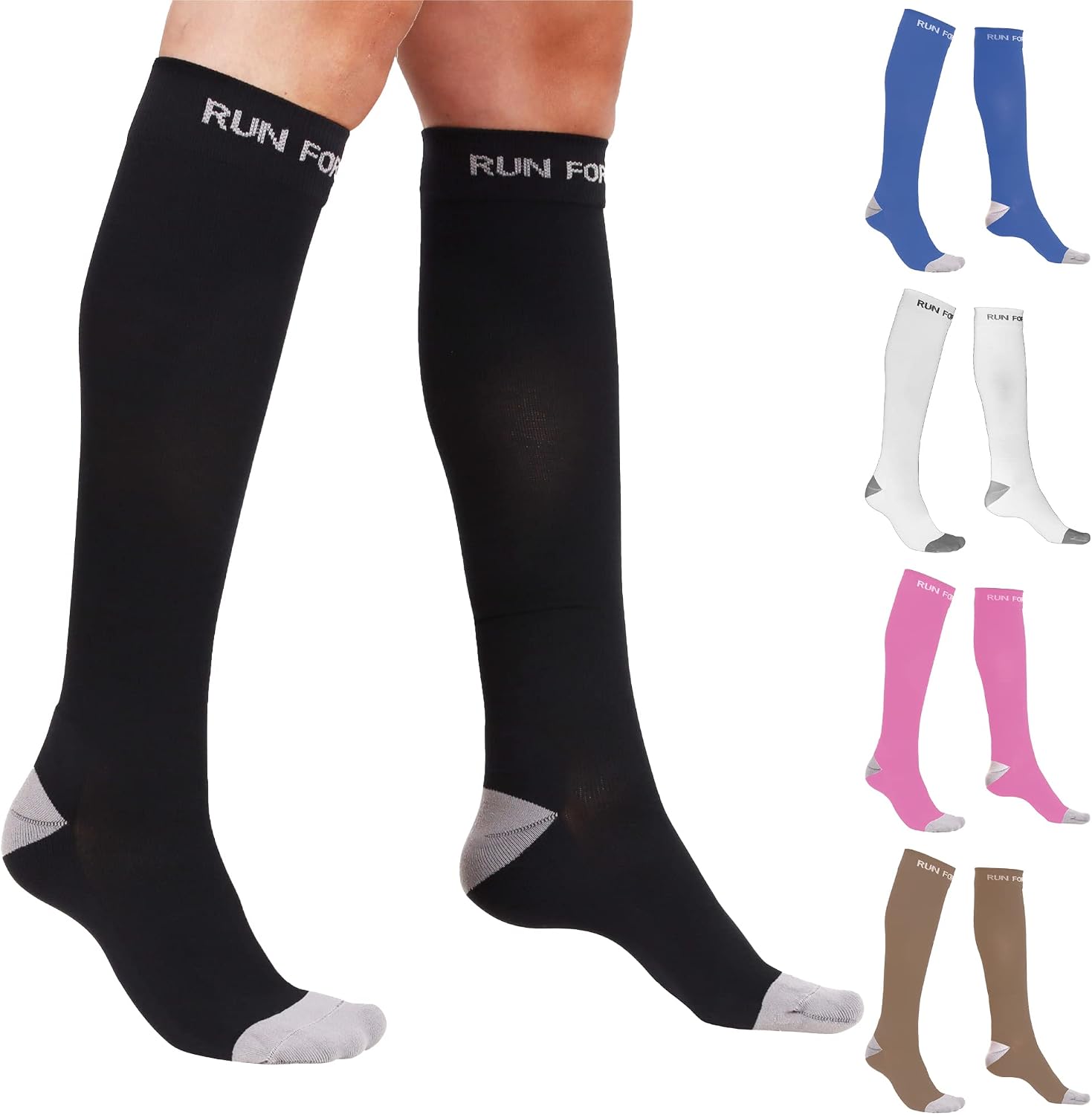
The honest case for the Run Forever is that firm compression is expensive and this is not. It delivers a stated 20-30 mmHg knee-high graduated compression at a fraction of what Sockwell or Sigvaris cost, and for a lot of people, particularly anyone who needs several pairs in rotation because compression socks wear out, that trade is the right one. What you give up is material quality. The nylon blend runs warmer than merino and does not manage odour as well over a twelve hour shift, and the compression will fade sooner. Treat it as a consumable and replace it on schedule and it is very good value. Treat it as a long-term purchase and you will be disappointed.
Pros
- Firm 20-30 mmHg at a budget price
- Solid review volume for a value brand
- Cheap enough to keep several pairs in rotation
Cons
- Nylon runs hot and holds odour over long shifts
- Compression fades sooner than premium pairs
- Basic construction and limited colour range
Best open toe
Doc Miller Open Toe Compression Socks 15-20 mmHg
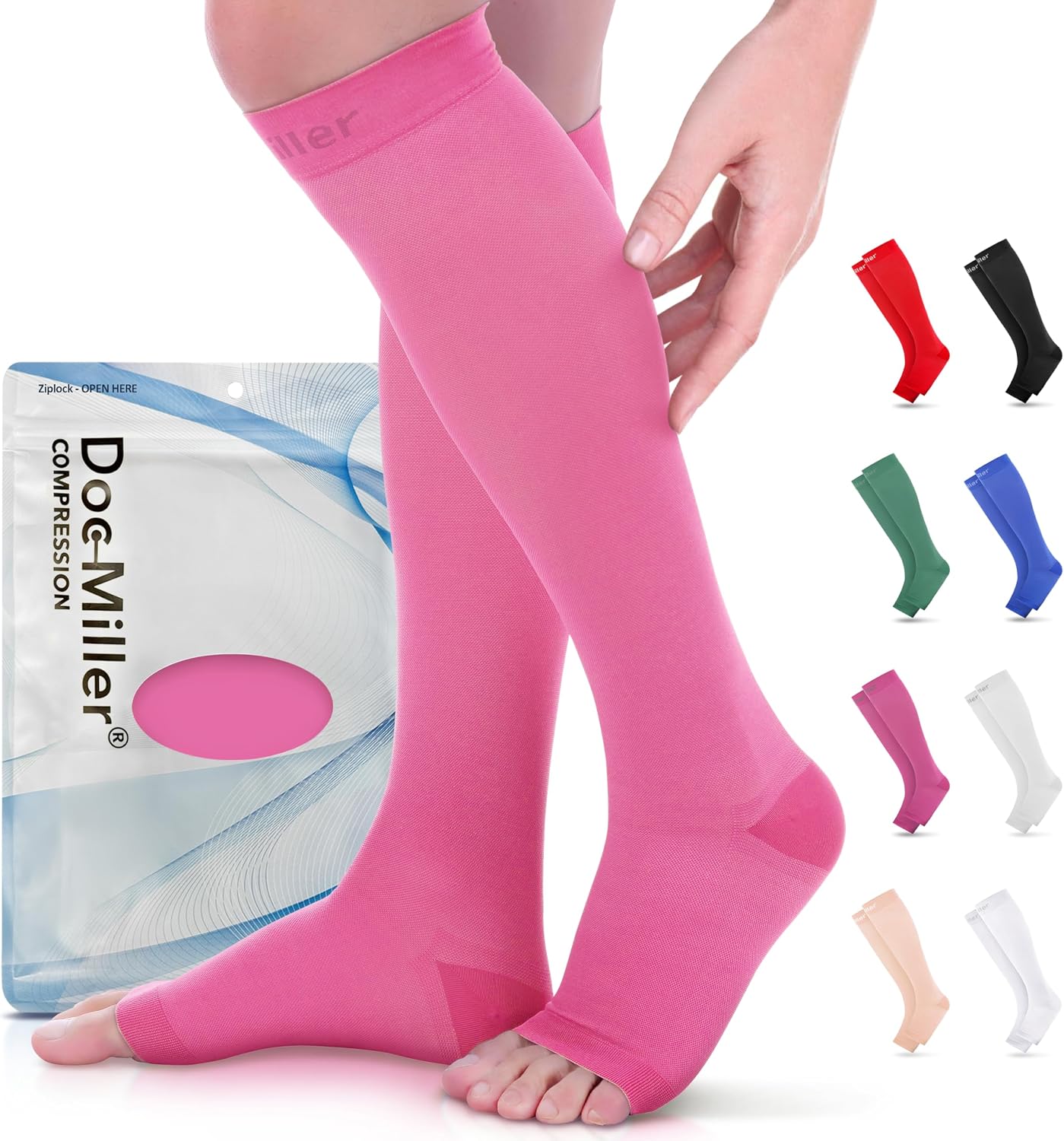
Every other sock here is closed toe, and for some people that is the dealbreaker. If a compression toe box pinches your toes, or you have nail problems, or you simply run hot, an open toe sleeve solves it outright and this is the best-evidenced cheap one we found. It is a footless design, so it applies graduated compression from ankle to knee and leaves your foot free, which also means you can wear it with sandals or with your own socks underneath. The trade is that your foot gets no support at all, so it is the wrong choice if your ankles are what swell. The nylon runs warm despite the open toe, and sizing consistency between colours is the recurring complaint. At this price it is a sensible thing to try alongside a closed toe pair.
Pros
- Open toe design is far easier to get on than a closed toe
- Avoids the hot, bunched feeling around the toes entirely
- Over two hundred owner reviews at a low price
Cons
- Footless sleeve leaves the foot unsupported
- Nylon construction runs warm
- Sizing reported as inconsistent between colourways
Also worth considering
Strong, well-reviewed products that just missed our ranked list - worth a look if the picks above aren't quite right for you.
- Sockwell Men's Elevation Firm Graduated Compression - The men's version of our top pick, same merino blend and same firm 20-30 mmHg. It only sits here rather than in the ranked list because we compared it directly against Vim & Vigr in a separate head to head.
- Sigvaris DYNAVEN Women's Calf-High 20-30 mmHg - A properly clinical option from a long-established medical compression manufacturer, with an open toe design that some people find far easier to don. Worth a look if you have been advised to wear firm compression and want a brand with a clinical rather than lifestyle background.
- JOBST Relief Knee High 20-30 mmHg - JOBST is one of the names clinicians recognise, and the Relief line is its accessible tier. The silicone dot band helps it stay up without a bite, which is a common complaint at this compression level.
Frequently asked questions
What compression level should I buy?
For standing all day, travel, or mild end-of-day swelling, 15-20 mmHg suits most people and is easy enough to put on that you will actually wear it. 20-30 mmHg is the firmer tier associated with visible varicose veins, more persistent swelling and post-surgical recovery, and it is meaningfully harder to don. Our mmHg guide covers the distinction in detail.
How do I stop compression socks digging in at the top?
That is almost always a calf circumference problem rather than a compression level problem. Compression socks are sized on leg measurements, and a standard cuff on a fuller or more muscular calf will leave a trench. The fix is a wide-calf model at the same mmHg, not a weaker sock.
Are merino wool compression socks worth it?
For all-day wear in a warm environment, yes. Merino regulates temperature and resists odour far better than nylon, which matters over a twelve hour shift. The trade-offs are price and drying time. For travel or gym recovery where you wear them for a few hours, nylon is fine and cheaper.
How often should I replace compression socks?
Every three to six months of regular wear. The compression comes from elastane, which degrades with every wash and stretch. A pair that still looks fine after two years is very likely delivering a fraction of its stated pressure, which is why people wrongly conclude compression socks stopped working for them.
Can I wear compression socks to bed?
Generally they are not worn overnight unless a clinician has advised it. The benefit is tied to being upright with gravity working against you. Lying flat removes most of that, and wearing firm compression while asleep means you cannot notice or respond to a fit problem.