The Best Anti-Fatigue Mats for Standing All Day (2026)
Cushioned anti-fatigue mats from ComfiLife, Sky Solutions, Gorilla Grip, Ergodriven and KANGAROO compared for kitchens, standing desks, workshops and salons.
If you stand in one spot for a living, or even for a long evening of cooking, the surface under your feet does more work than almost anything else you can buy. Concrete gives back nothing. Tile over concrete gives back nothing. A good anti-fatigue mat is the cheapest meaningful change you can make, and unlike shoes it works whether you are in trainers, slippers or socks.
We compared five mats on the five criteria we use across this site: support, comfort, durability, fit and value. The short version is that the ComfiLife is the best all-rounder, the Sky Solutions is the one to buy for a kitchen, and the Topo by Ergodriven is a genuinely different product that solves a problem flat mats cannot.
How an anti-fatigue mat actually helps
The common explanation is that a mat is soft and softness is comfortable. That is not really it, and it leads people to buy mats that are far too plush.
Standing still is hard on you because your blood relies on calf muscle contraction to get back up your legs. Stand rigidly on concrete and those muscles barely move, circulation slows, and you get the familiar ache in the feet, calves and lower back. A mat with the right amount of give makes you subtly unstable, so your feet and calves make constant tiny corrections. Those corrections are muscle contractions, and muscle contractions move blood.
This is why the firmness matters more than the thickness. Too firm and you get no movement. Too soft and you sink, your ankles work overtime in a bad way, and you end up more tired than you started. Around 3/4 of an inch of dense foam is the sweet spot, which is where most of these mats have landed.
It is also why a mat is not a complete answer on its own. It addresses the surface, not the blood pooling. Anyone standing a full shift is usually better served by a mat plus graduated compression socks, which act on circulation directly.
How we picked
We prioritised mats that are single, buyable items with a long and credible review history rather than newly listed products with a handful of reviews. Every mat here has thousands of owner reviews, and three of the four have well over fifteen thousand.
We scored on:
- Support: how much load the mat genuinely takes off the legs, and whether it stays stable underfoot.
- Comfort: how it feels over hours, not seconds.
- Durability: whether the foam holds its loft, and how the edges hold up.
- Fit: size options, and whether the shape suits the place you would actually put it.
- Value: what you get for the money, factoring in how long it lasts.
We did not test on carpet. If your floor is carpeted, the benefit of any of these will be much smaller.
Matching a mat to where you stand
At a standing desk, you move least, which is the hardest case. This is where the Topo pulls away from the field: its terrain gives you positions to move between, and it does not need to be walked across. The main annoyance is that you cannot roll a chair onto it, so it lives beside the desk half the time.
At a kitchen sink or stove, you move laterally and you get splashed. Prioritise a wipe-clean surface and length over outright cushioning. The Sky Solutions in a 39 inch or longer size is the pick. Kitchens are the one case where the size decision matters more than the brand: run length beats cushioning depth, because a mat that stops short of the sink leaves you standing off it half the time.
On workshop or garage concrete, prioritise density and edge durability, because the mat gets dragged and things get dropped on it. The ComfiLife holds up best here of the four.
In a salon or behind a bar, where you pivot constantly, avoid the softest options. A softer mat makes pivoting feel unstable. The ComfiLife again, in the larger size.
Thickness, edges and the details that matter
Thickness. Three quarters of an inch is the standard and the right answer for most people. Half an inch feels firm and is easier to roll a chair over. Anything over an inch tends to feel unstable and creates a real trip hazard.
Edges. Bevelled edges are not a cosmetic feature. A square-edged mat is something you will catch a toe on, and it is the first part to curl and fail. Every mat here is bevelled to some degree; the Gorilla Grip is the least well finished.
Backing. A textured or gripped backing matters most on smooth tile and sealed concrete. On unsealed concrete or hardwood, almost anything stays put.
Floor safety. Check for phthalate-free construction if the mat sits on luxury vinyl plank, and lift it occasionally. This is the one genuine risk to your floor, and it develops over months rather than days.
What we would buy
For most people, in most rooms, the ComfiLife. It is the most complete mat here and the foam density is the reason: it is the one least likely to be flat and useless in eighteen months.
For a kitchen specifically, the Sky Solutions in the longest size your run allows.
If the floor under the mat is concrete, it is worth reading why that surface is harder on you than any other, because a mat is only one of the changes worth making there. For the wider picture, our standing all day at work guide sets out where a mat sits against shoes, movement and compression.
For a standing desk where you are genuinely stationary for hours, the Topo is worth the extra money and the inconvenience, because it is the only one addressing the actual problem of not moving.
And if the mat is for occasional use, the Gorilla Grip does the job for less.
If you are dealing with aching legs at the end of a shift rather than just sore feet, a mat is only half the fix. Our guide to compression levels and what the mmHg numbers mean covers the other half, and our roundup of the best compression socks has the specific picks.
How we test
Every pick is scored on the same five criteria and cross-checked against real owner feedback - so the ranking reflects how a product holds up over a full shift, not its spec sheet.
Support
Whether graduated compression actually matches its stated mmHg rating, or, for mats and insoles, how much load it takes off your legs.
Comfort
All-day wearability: no bite at the cuff, no hotspots, breathable enough for a full shift.
Durability
Whether it holds compression or loft after repeated washing and months of daily use.
Fit
Size range, calf-width options, and how honest the sizing chart is against real owner reports.
Value
What you get for the price, including cost per wear once durability is accounted for.
Best overall
ComfiLife Anti Fatigue Floor Mat
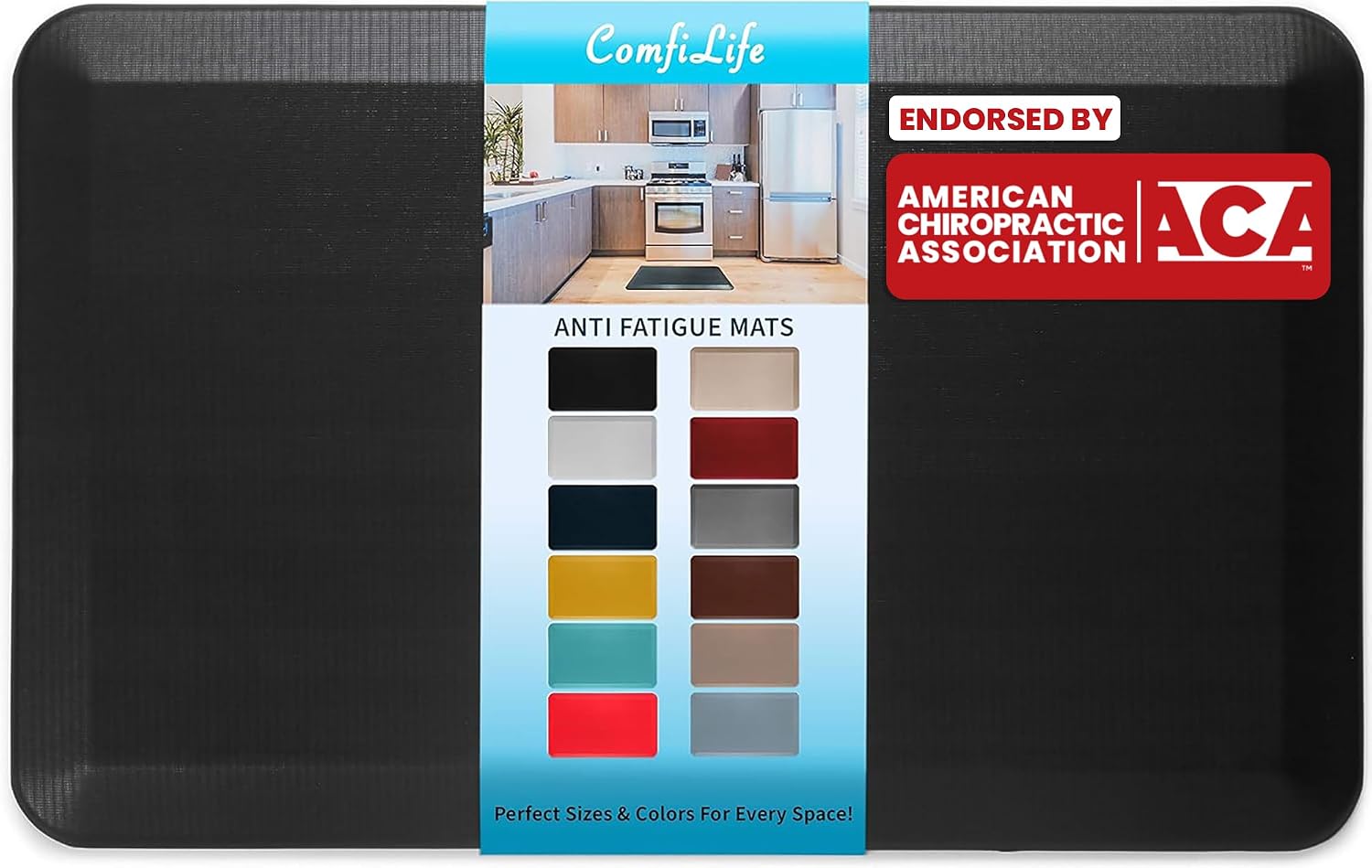
The ComfiLife is the mat we would buy without thinking too hard about it. The 3/4 inch high-density foam core hits the balance that most mats miss: enough give that your calves keep making small adjustments, firm enough that you are not wobbling or sinking. Owners consistently report it holds its loft rather than compressing into a flat pancake after a few months, which is the failure mode that kills cheap foam mats. The textured non-slip backing genuinely stays put on smooth tile and sealed concrete, and the bevelled edges are low enough that you stop noticing them within a day. At 20 by 32 inches it suits a standing desk or a sink position; the 20 by 39 inch version is the one to get for a stove or a longer prep counter.
Pros
- 3/4 inch high-density foam keeps its loft rather than flattening out
- Non-slip backing holds on tile, sealed concrete and hardwood
- Bevelled edges reduce the trip hazard and let a chair roll on
- Wipes clean, so it survives a kitchen
Cons
- Only one firmness option, which will feel soft if you prefer a firm platform
- The lighter colourways show scuffs in a workshop setting
Best for kitchens
Sky Solutions Anti Fatigue Mat
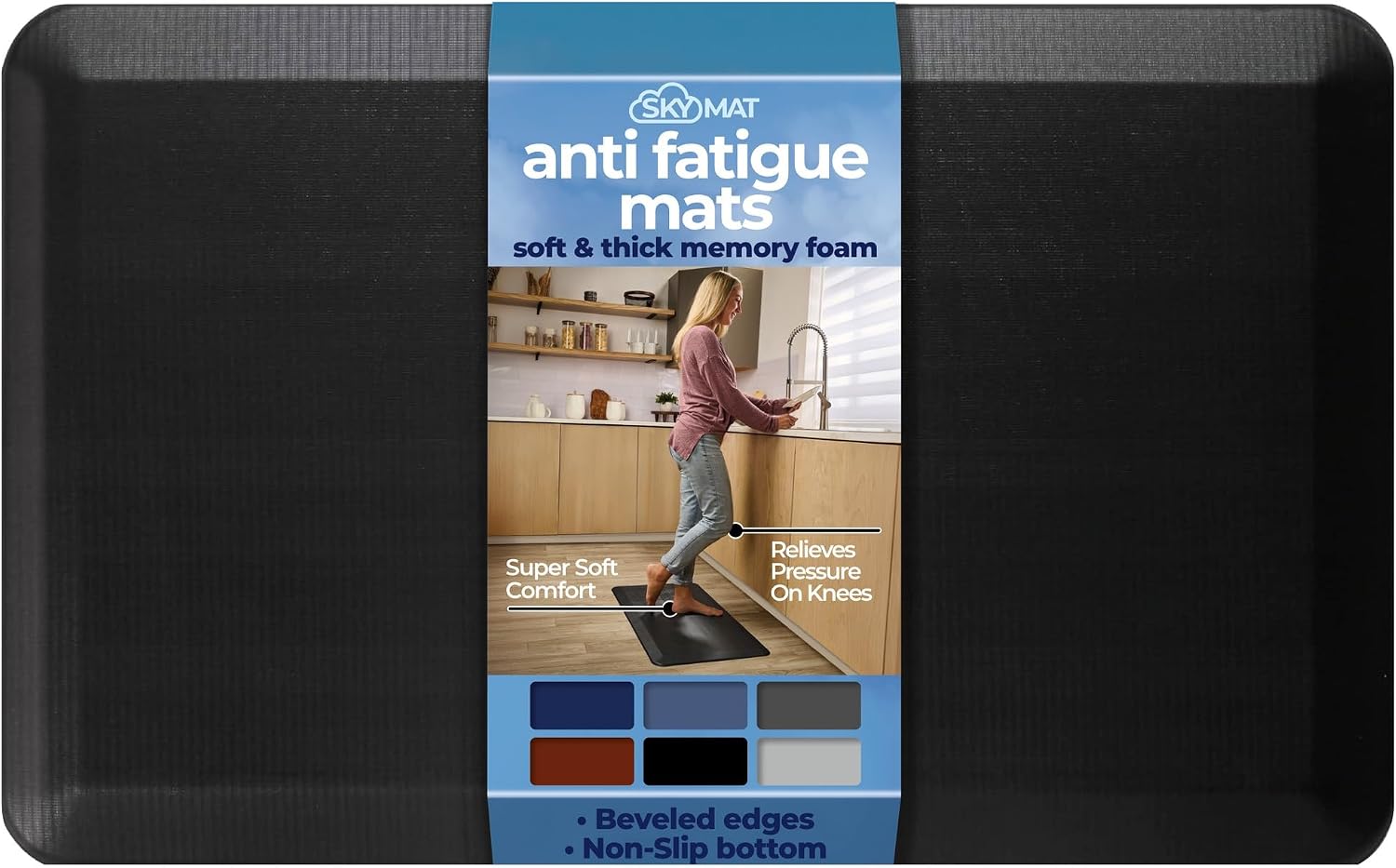
The Sky Solutions is the most kitchen-ready mat here, and it is the one to pick if the mat will spend its life somewhere that gets splashed. The diamond-textured top sheds water and wipes down without holding grease in a texture, which matters more than it sounds when the mat lives in front of a sink. It runs slightly softer than the ComfiLife, which is a real advantage during a long cooking session and a slight disadvantage if you want a stable base for lifting. The size range is the best of any mat here, spanning 20 by 32 through to 20 by 70 inch runners, so you can actually match the mat to a galley kitchen instead of stepping on and off a short one all evening.
Pros
- Widest size range on test, including long runners for galley kitchens
- Diamond texture sheds water and wipes clean easily
- Softer feel that suits long stationary cooking sessions
- Waterproof and stain resistant in practice, not just on the label
Cons
- Softer core feels less stable if you are lifting anything heavy
- The texture collects crumbs and needs an occasional shake out
Best for standing desks
Topo by Ergodriven
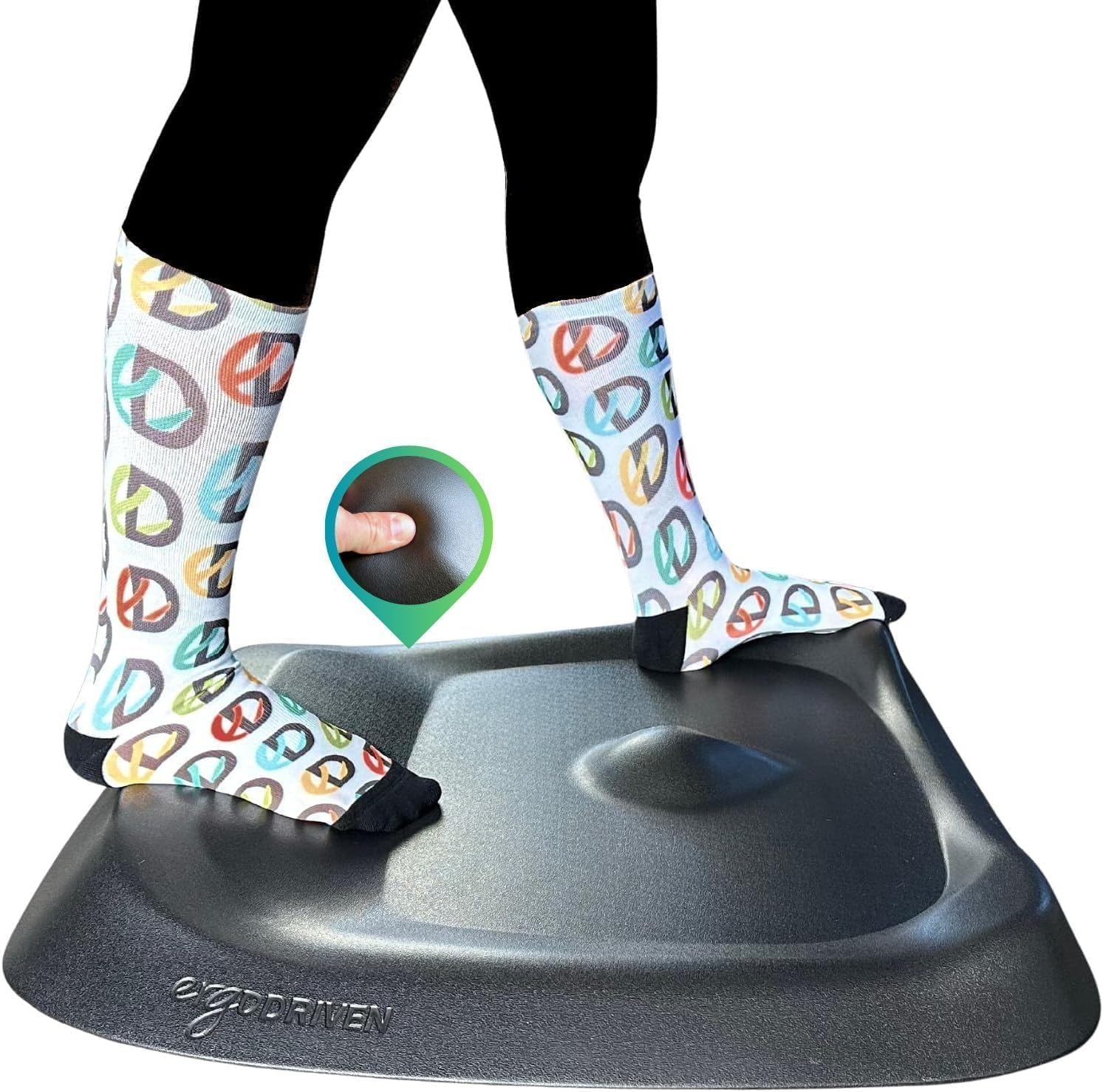
The Topo is the only mat here that is not flat, and that is the entire point. Instead of a uniform cushion, it has a calculated terrain of mounds, edges and a raised perimeter that give you somewhere to put your feet: you lean on an edge, stretch a calf over a mound, perch a heel. If you have ever found that even a good flat mat stops helping after ninety minutes, this is the answer, because it keeps offering your body new positions rather than one slightly softer version of standing still. The foam is dense and shows no meaningful compression after years of use. The trade-offs are real though. It is the most expensive mat here, it is too bulky and odd-looking for a kitchen, and a chair will not roll over it, so you are moving it aside every time you sit.
Pros
- Terrain design keeps giving you new standing positions, not just cushioning
- Very dense foam that resists compression over years
- Built-in calf and arch stretch points
- PVC free
Cons
- Most expensive mat on this list by a wide margin
- Bulky and awkward to move aside when you want to sit
- Wrong shape and look for a kitchen
Best budget pick
Gorilla Grip Anti Fatigue Mat
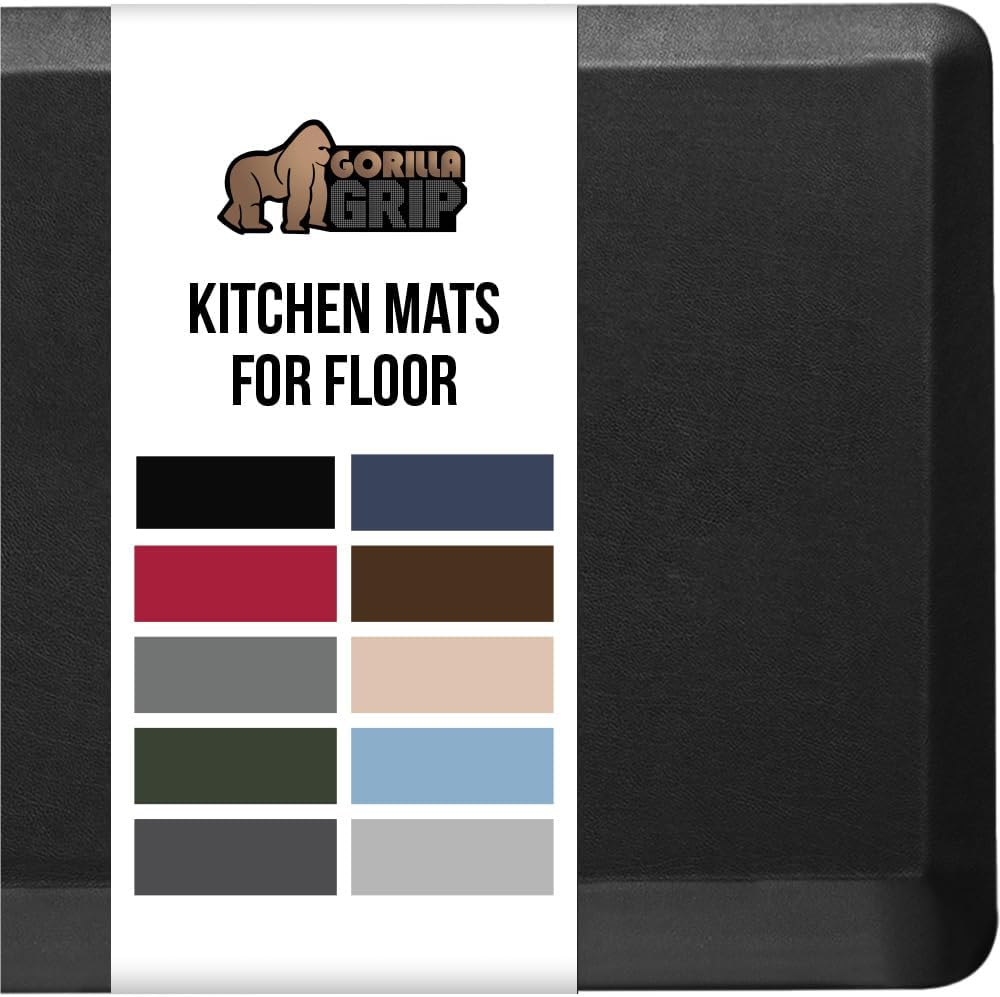
The Gorilla Grip does most of what the ComfiLife does for noticeably less money, and for a mat that will see a few hours of use a day rather than a full shift, that is a sensible trade. Same 3/4 inch thickness, same pebbled waterproof top, and a wide enough colour range that it can be made to look deliberate in a kitchen. Where it gives ground is longevity: the foam is a little less dense, and it is the one mat here where owners more often report the cushioning softening after a year of heavy daily standing. If you are on it eight hours a day on concrete, spend more. If it is for evening cooking or a home office you use intermittently, this is the value pick and it is not close.
Pros
- Substantially cheaper than the ComfiLife for similar specs on paper
- Waterproof pebbled top is easy to clean
- Broad colour and size selection
Cons
- Foam is less dense and softens sooner under heavy daily use
- Edges are less well bevelled, so they can curl over time
Best for a wet kitchen
KANGAROO Cushioned Anti Fatigue Mat
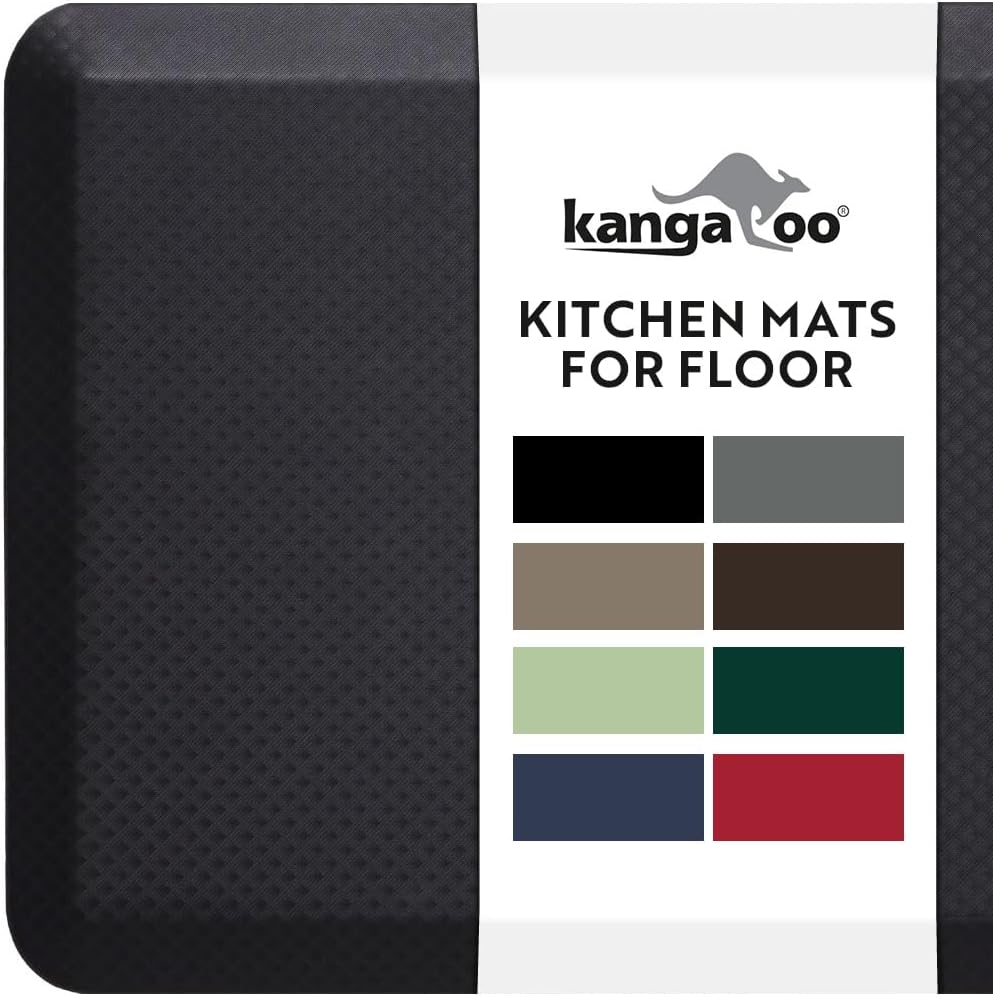
The Kangaroo sits between the ComfiLife and the Gorilla Grip, and with over seventeen thousand owner reviews it is one of the best-evidenced mats on Amazon. Same 3/4 inch construction, but the surface is the differentiator: it is genuinely waterproof rather than merely stain resistant, and it wipes down completely, which is why it is the one we would put in front of a sink rather than at a desk. The size range is the widest here, running from a compact 17x24 through to 60x20 runners, so it is the easiest to match to an awkward space. It is firmer underfoot than the Sky Solutions, which suits pivoting and lifting better than long stationary standing. The edges are the weak point, less well bevelled than the ComfiLife and the first part to show wear.
Pros
- Over seventeen thousand owner reviews
- Genuinely waterproof surface, not just stain resistant
- Widest size range here, from 17x24 to 60x20
- Firmer feel suits pivoting and lifting
Cons
- Edges less well bevelled and the first thing to wear
- Firmer than some will want for long stationary standing
- Plain looks compared with the patterned options
Also worth considering
Strong, well-reviewed products that just missed our ranked list - worth a look if the picks above aren't quite right for you.
- ComfiLife Anti Fatigue Mat, 20 x 39 inch - Our best overall pick in the longer size. Mat length is a primary buying decision rather than a detail, and if you are covering a stove or a prep counter rather than a single standing spot, this is the size to order instead.
- Sky Solutions Anti Fatigue Mat, 20 x 39 inch - Likewise the longer version of our kitchen pick, and the one to get for a galley layout where a short mat means stepping on and off it all evening.
- Dr. Scholl's Work All-Day Insoles - Not a mat, but worth knowing if you move between spots rather than standing in one. A mat only helps where it is; an insole travels with you, and the two solve different halves of the same problem.
Frequently asked questions
Do anti-fatigue mats actually work?
They change how you stand rather than simply adding padding. A mat with enough give encourages constant micro-adjustments in your feet, ankles and calves, so the muscles keep working gently instead of locking in one position. That is where the relief comes from. The effect is most noticeable on unforgiving surfaces like concrete and tile, and least noticeable on carpet, which already provides some give.
How thick should an anti-fatigue mat be?
Three quarters of an inch is the standard for home and office use and is what most of the mats here use. Thinner mats around half an inch feel firmer and are easier to roll a chair over. Thicker mats above one inch feel plush at first but can make you feel unstable, and they are a trip hazard at the edges unless the mat is properly bevelled.
What size anti-fatigue mat do I need?
For a standing desk, 20 by 32 inches covers a normal stance with room to shift your weight. For a kitchen sink or a stove, 20 by 39 inches is the common pick because you move laterally more than you do at a desk. For a galley kitchen or a long workbench, a 20 by 60 inch runner avoids the problem of stepping on and off a short mat all day.
Will an anti-fatigue mat damage my floor?
Quality polyurethane mats are generally safe on sealed hardwood, laminate, tile and vinyl. The risk comes from cheap mats with plasticiser-heavy backings, which can discolour vinyl over months of contact. Check that the mat is phthalate free and lift it occasionally to let the floor breathe, particularly on luxury vinyl plank.
Anti-fatigue mat or better shoes: which matters more?
If you stay in roughly one spot, the mat does more, because it works even in socks or slippers and never wears out its cushioning the way a shoe midsole does. If you walk several miles a shift, footwear matters more. People who stand on concrete all day usually need both, plus compression socks to deal with the blood pooling that neither a mat nor a shoe addresses.