The Best Thigh High Compression Stockings (2026)
Thigh high 20-30 mmHg compression stockings from Truform, JOBST and Doc Miller compared on support, comfort, durability, fit and value, including how to stop them rolling down and when knee highs are the better choice.
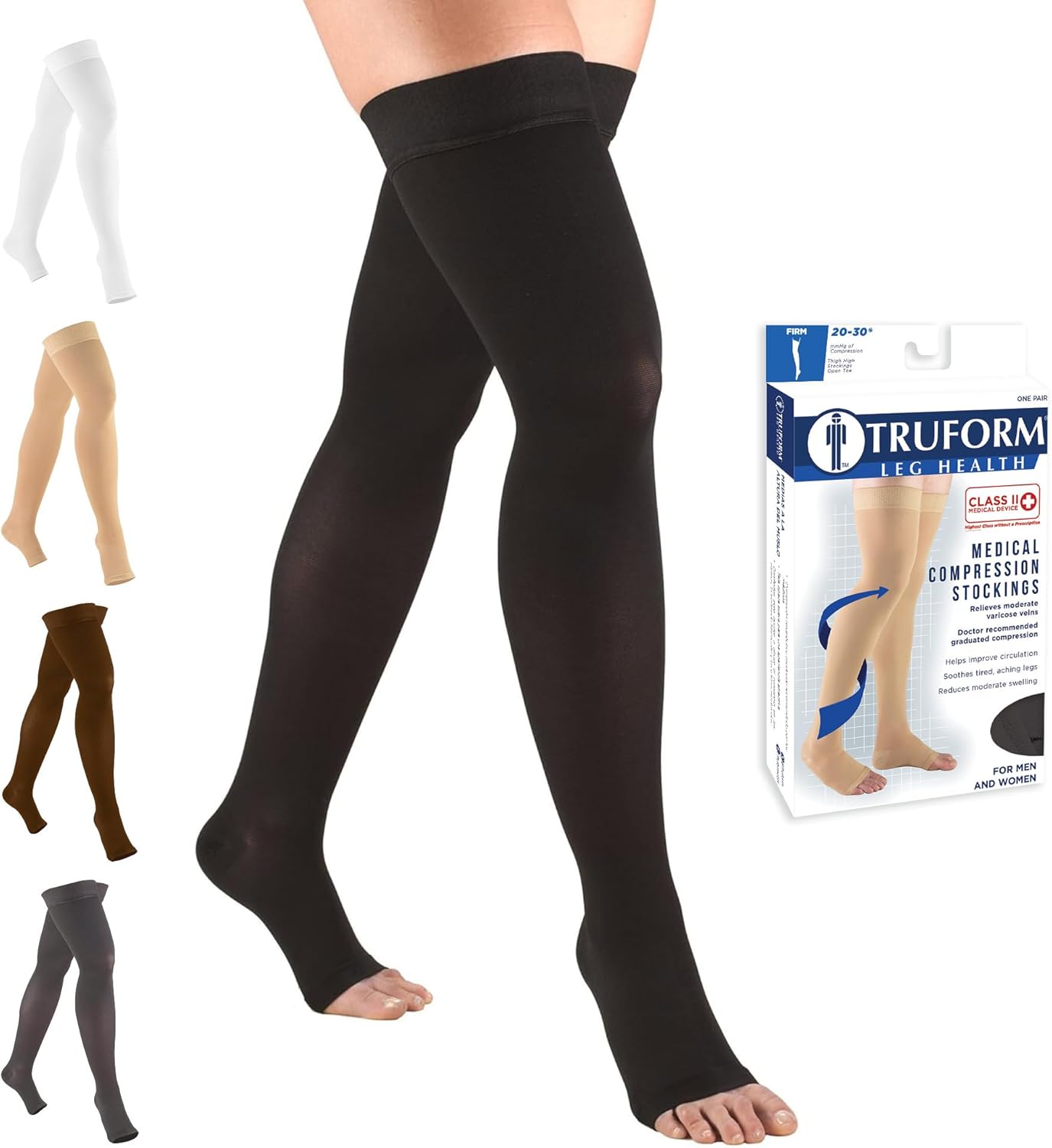
This is not medical advice. Thigh high compression at 20-30 mmHg is usually worn for a diagnosed reason. The length and compression level appropriate for your legs should come from a clinician who has assessed them, not from a review page.
Thigh high compression stockings solve a specific problem: symptoms or veins that extend above the knee. If your swelling stops at the calf, which is by far the more common case, a knee high is the easier and better answer, and we will say that plainly before recommending anything.
If you do need thigh coverage, the decision comes down to one thing more than any other: whether the stocking stays up.
Our picks at a glance
- Best overall: Truform Dot-Top Open Toe, the sensible default with the strongest review record
- Best for staying up: JOBST Relief with silicone band, the most effective anti-slide solution here
- Best value: Doc Miller, with the widest plus size range
Should you actually buy thigh highs?
It is worth being honest that a lot of people buy thigh highs when a knee high would serve them better.
Knee highs treat the ankle and calf. That is where the great majority of swelling accumulates and where most visible varicose veins sit, because that is where venous pressure is highest. They are easier to put on, much easier to keep up, cooler, and cheaper.
Thigh highs make sense when symptoms or veins extend above the knee, after certain surgical procedures, or when a clinician has specified the length. They are not a stronger version of a knee high. The compression rating is identical; only the coverage differs.
If nobody has told you that you need thigh coverage, start with our knee high picks and save yourself the fitting difficulty.
The staying-up problem
This is the defining issue with thigh highs, and it is worth understanding before you blame the product.
Sizing is the usual culprit. A stocking that is even slightly too large in the thigh will slide, and no silicone band compensates for that. Thigh circumference varies enormously between people, far more than ankle circumference, which is why size charts here matter more than in knee highs.
Band type is second. A plain elasticated top slides most. Silicone dots grip better. A continuous silicone band, as on the JOBST, grips best, at the cost of possible skin irritation for some people. Band style varies across JOBST’s lines, so it is worth knowing which one you are buying rather than assuming the brand alone settles it.
Skin preparation is the overlooked one. Body lotion, oil or moisturiser on your thighs defeats silicone completely. If a band that used to work suddenly stops, this is very often why.
Age matters. A stocking that has lost elasticity slides. If yours has been in rotation over six months, the problem may simply be that it is worn out.
Measuring, in three numbers
Thigh highs need three measurements, all taken first thing in the morning before swelling develops:
- Ankle circumference at the narrowest point, just above the ankle bone. This is where the rated pressure is delivered, so it is the critical one.
- Calf circumference at the widest point.
- Thigh circumference at the widest point, usually just below the buttock.
Some brands also ask for floor to gluteal fold length, and offer short and long variants. If you are tall or petite, that variant matters as much as the circumference.
Measuring an already-swollen leg in the evening gives you a stocking that is too loose the following morning, which is both less effective and much more likely to slide.
Getting them on
A 20-30 mmHg thigh high is genuinely hard work, and most people who abandon them do so at this stage rather than because of how they feel once on.
What helps: put them on before getting out of bed, or at least before standing for any length of time. Wear rubber washing-up gloves, which give far more grip than bare hands and stop fingernails laddering the fabric. Turn the stocking inside out down to the heel, seat the heel first, then roll it up the leg rather than hauling from the top. A donning aid is worth the small cost, and works best with an open toe.
This is the main practical argument for choosing open toe on a thigh high specifically: there is roughly twice as much fabric to manage as a knee high, and an open toe with a slip sock makes it considerably easier.
They wear out, and it shows up as sliding
Elastane degrades with washing and stretching, and manufacturers put the useful life of a compression stocking at roughly three to six months of regular wear.
In a knee high, a worn out pair quietly stops delivering its rated compression. In a thigh high you usually get an earlier warning, because the first thing to fail is the grip at the top. If yours has started sliding and it is more than a few months old, that is the answer.
Keep two or three pairs in rotation, wash cool without fabric softener, which coats and destroys the fibres, and air dry. This is the honest case for including a budget option: consistent wear matters more than premium materials, and consistency is easier when replacing them does not sting.
Where to go next
If you are still unsure between compression levels rather than lengths, our mmHg guide covers 15-20 against 20-30 and why higher is not automatically better.
If you landed here because your legs ache after standing rather than because of a vein diagnosis, thigh highs are a heavier tool than you need. Our general compression roundup and our picks for long shifts both centre on the gentler everyday level.
How we test
Every pick is scored on the same five criteria and cross-checked against real owner feedback - so the ranking reflects how a product holds up over a full shift, not its spec sheet.
Support
Whether graduated compression actually matches its stated mmHg rating, or, for mats and insoles, how much load it takes off your legs.
Comfort
All-day wearability: no bite at the cuff, no hotspots, breathable enough for a full shift.
Durability
Whether it holds compression or loft after repeated washing and months of daily use.
Fit
Size range, calf-width options, and how honest the sizing chart is against real owner reports.
Value
What you get for the price, including cost per wear once durability is accounted for.
Best overall
Truform 20-30 mmHg Thigh High, Dot-Top, Open Toe
Truform is the sensible default in thigh highs for the same reason it is in knee highs: an enormous, consistent review base and a price that makes replacing them on schedule realistic. With over four thousand owner reviews on this listing alone it has far more real-world data behind it than the specialist brands, and owners rate it well on even compression through the calf and thigh. The silicone dot top is the feature that matters most in a thigh high, and it grips reliably without needing a punishing band. This is an open toe version, which is the right choice for a thigh high because there is a lot of fabric to work up the leg and an open toe lets you use a donning aid properly. What you give up is refinement. It is plainly medical in appearance, the fabric is heavier than the premium options, and it runs warm in summer.
Pros
- Over four thousand reviews on this listing, the strongest record here
- Silicone dot top grips without an over-tight band
- Open toe makes a thigh high far easier to put on
- Cheap enough to keep two or three pairs in rotation
Cons
- Distinctly medical in appearance
- Heavier fabric that runs warm
- Sizing runs on the generous side, so measure carefully
Best for staying up
JOBST Relief Thigh High 20-30 mmHg, Silicone Band
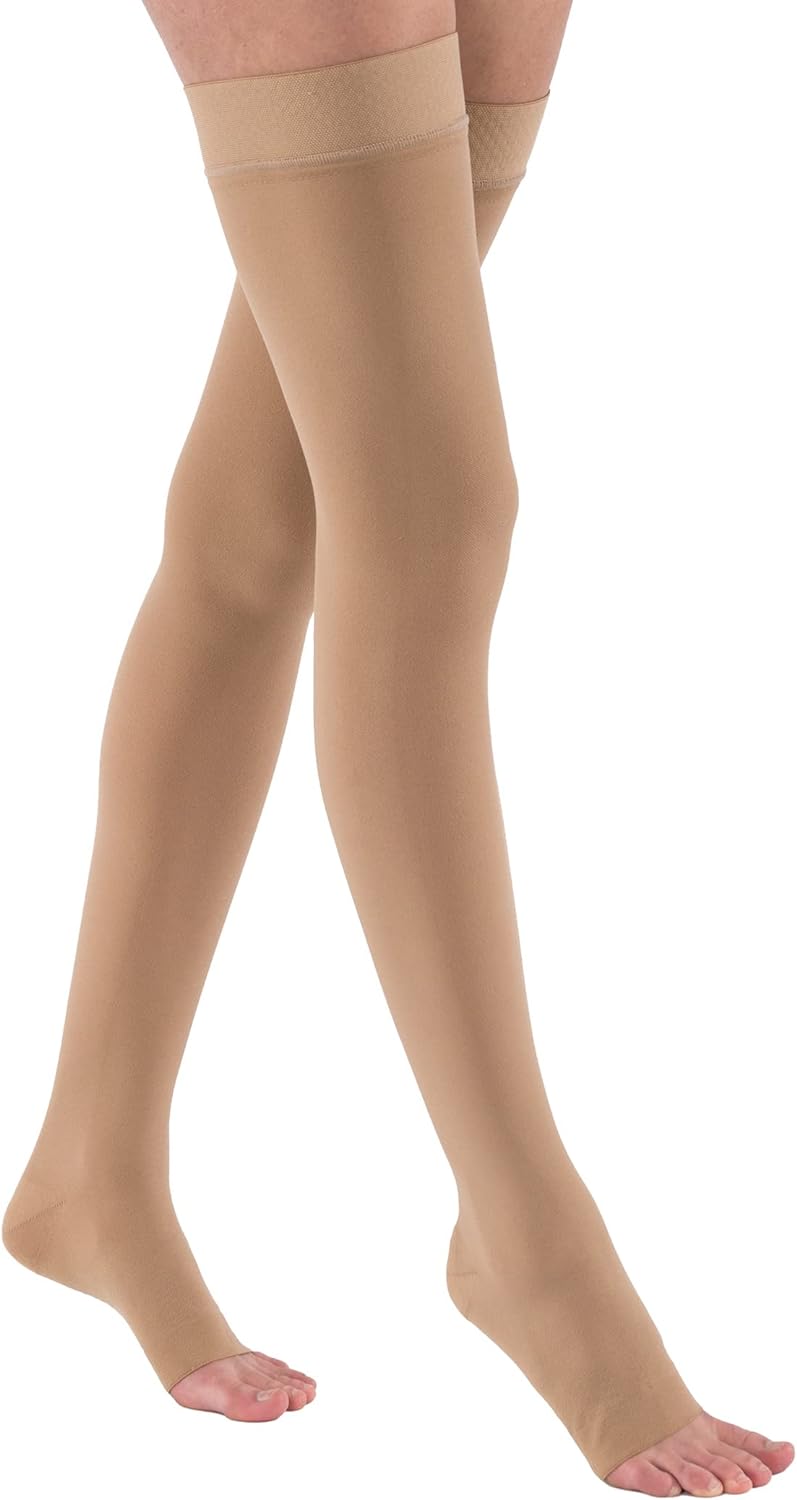
The single most common complaint about thigh high compression is that it slides down by lunchtime, and JOBST's silicone band is the most effective answer we found. It is a continuous band rather than scattered dots, and it holds position without the cuff needing to be brutally tight, which is the usual trade people are forced into. JOBST is also a brand clinicians actually recognise, and Relief is its accessible tier, so you get proper medical construction without the premium line's price. With over a thousand reviews on this listing it is well evidenced. Two caveats worth knowing. Silicone bands can irritate genuinely sensitive skin, and a small number of owners react to them. And you must not apply lotion or oil to your thighs before donning, because it defeats the silicone entirely, which is a surprisingly common cause of a band that suddenly stops working.
Pros
- Continuous silicone band is the best anti-slide solution here
- Clinically recognised brand at an accessible price
- Over a thousand owner reviews
- Open toe version is much easier to don
Cons
- Silicone can irritate very sensitive skin
- Lotion or oil on the thigh defeats the band
- Plain, medical appearance
Best value
Doc Miller Thigh High Compression Stockings 20-30 mmHg
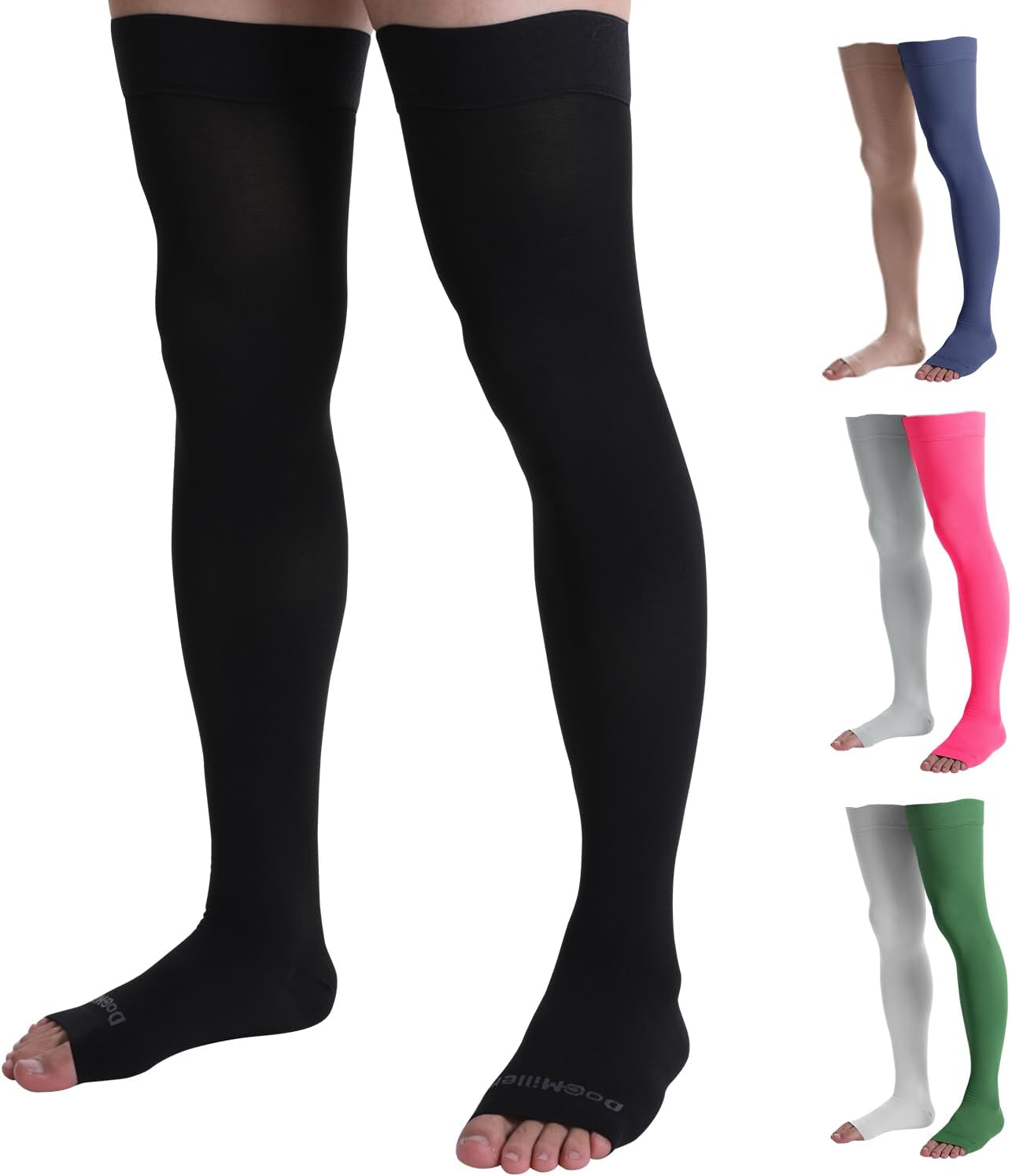
Doc Miller is the budget route into thigh high compression, and given that these are a long-term purchase you replace two or three times a year, cost per month is a fair thing to weigh. It offers a stated 20-30 mmHg with a size range that extends further into plus sizes than most, which is a genuine gap in this category since thigh circumference varies far more between people than ankle circumference does. With over five hundred reviews it is reasonably well evidenced for a value brand. Be realistic about the trade. Owner reports point at compression softening sooner than the specialist brands, and sizing consistency between colourways is the recurring criticism. At this price, buying two pairs and replacing them more often is a perfectly workable strategy, but it is not Truform longevity.
Pros
- Lowest price here for stated 20-30 mmHg
- Size range extends further into plus sizes than most
- Over five hundred owner reviews
Cons
- Compression softens sooner than the specialist brands
- Sizing reported as inconsistent between colourways
- Band is less effective than the JOBST silicone
Best budget closed toe
Beister Thigh High Compression Stockings 20-30 mmHg, Closed Toe
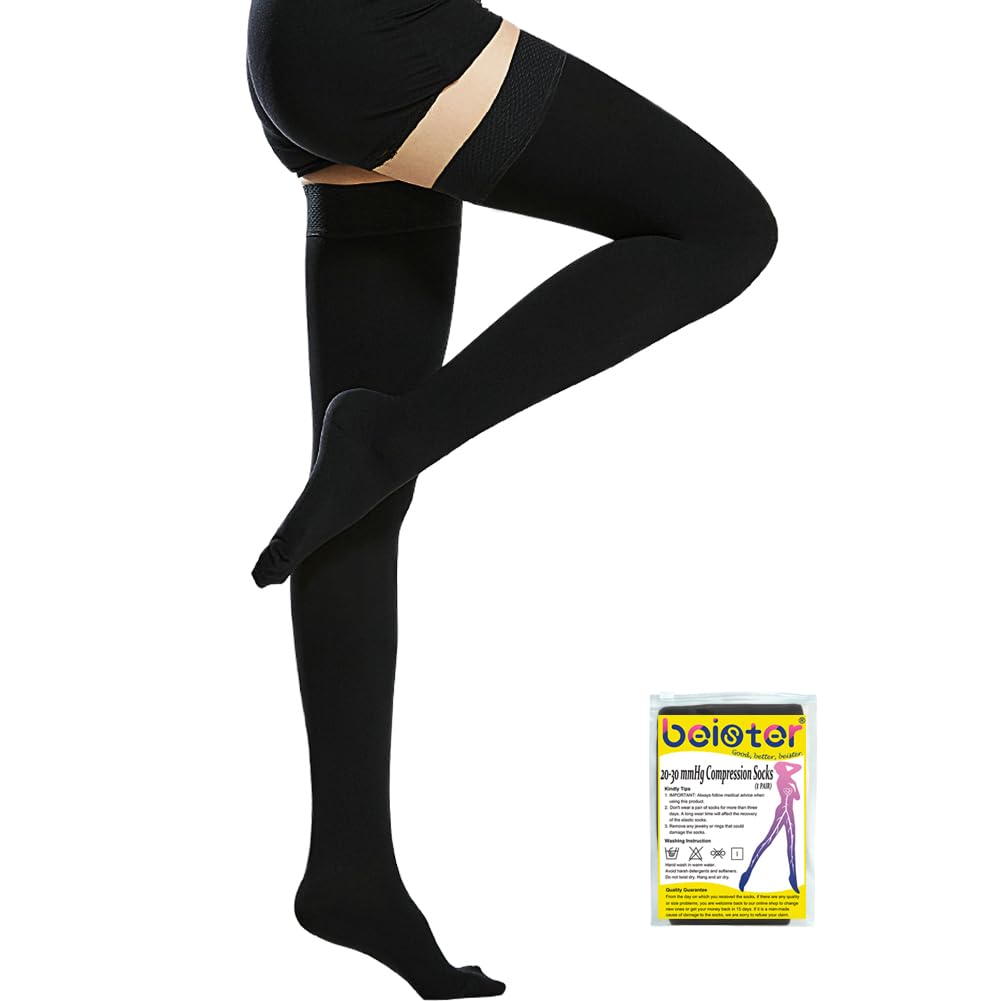
Every other thigh high here is open toe, which is the easier design to don but not what everyone wants in January. Beister is the closed toe option, and with over a thousand owner reviews it is the best-evidenced one at this price. It has a silicone band, a stated 20-30 mmHg, and it costs meaningfully less than Truform or JOBST. It feels more like a stocking and less like medical equipment than the beige options, which matters if it is visible. The compromises are the usual budget ones: compression softens sooner than the specialist brands, and the closed toe makes an already difficult garment harder to get on, so budget a donning aid if you go this route.
Pros
- Closed toe option, warmer than the open toe picks
- Over a thousand owner reviews
- Silicone band at a budget price
Cons
- Closed toe is harder to don at 20-30 mmHg
- Compression softens sooner than Truform or JOBST
- Sizing runs small according to owners
Best moderate option
Beister Thigh High Footless Sleeves 15-20 mmHg
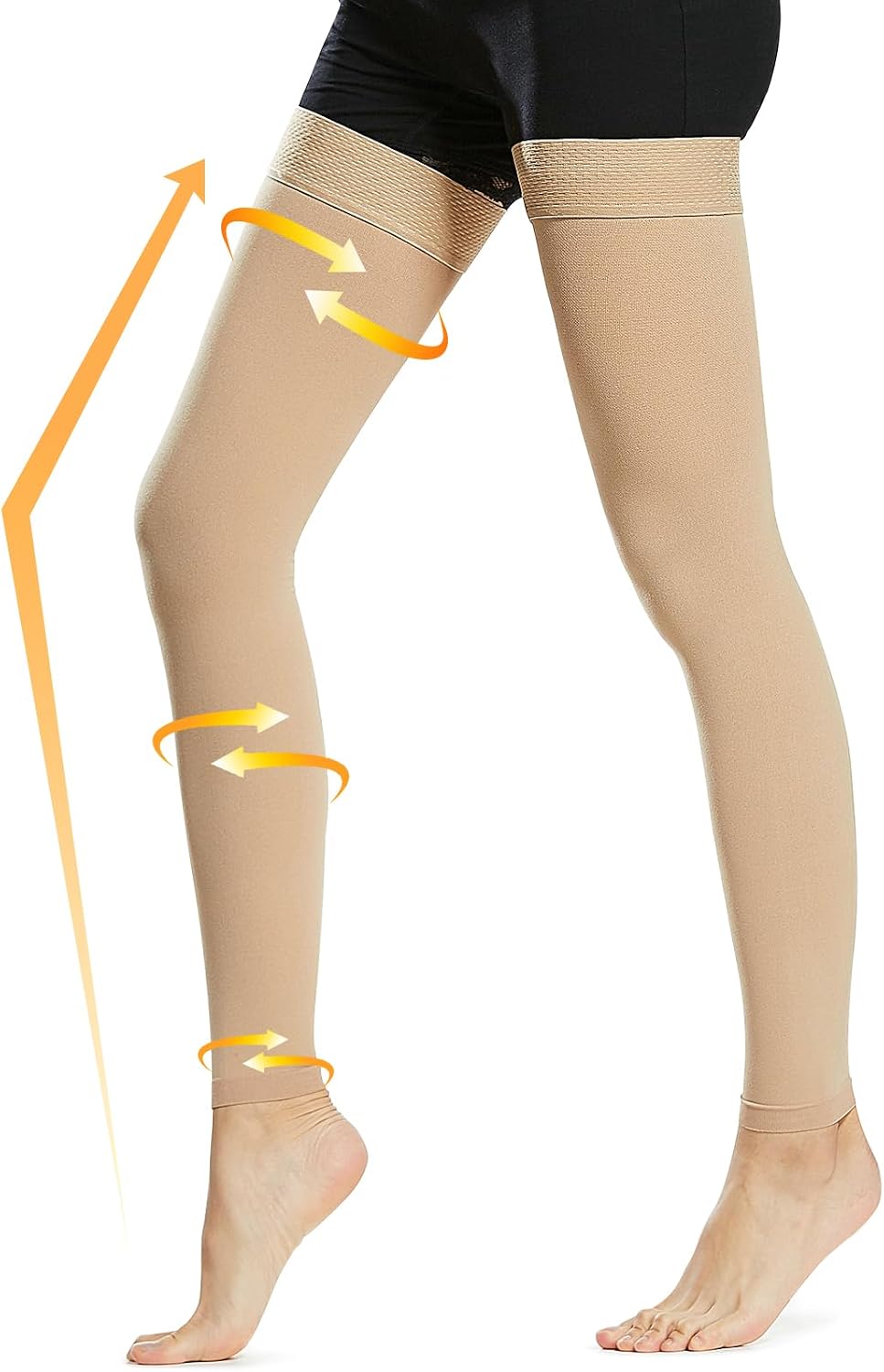
Everything else on this page is firm 20-30 mmHg, which is the level thigh highs are usually bought at. This is the moderate alternative, and it exists for a real reason: if you want thigh coverage for aching and heaviness rather than for a diagnosed vein condition, 20-30 mmHg is more than you need and considerably harder to live with. At 15-20 mmHg this goes on far more easily, and the footless sleeve design removes the hardest part of donning a thigh high entirely. It has a dot silicone band to keep it up. The limitations follow: it is the least supportive option here, it does nothing for your foot or ankle, and with under two hundred reviews it is the least evidenced. Buy it for comfort, not for management of a diagnosed condition.
Pros
- Much easier to put on than any 20-30 mmHg thigh high
- Footless sleeve removes the hardest part of donning
- Dot silicone band helps it stay up
Cons
- Least supportive option here
- No foot or ankle coverage at all
- Smallest review base on this page
Also worth considering
Strong, well-reviewed products that just missed our ranked list - worth a look if the picks above aren't quite right for you.
- Truform 20-30 mmHg Knee High - Worth considering before you commit to thigh highs. If your swelling and veins are below the knee, which is the common case, a knee high is easier to wear, easier to keep up, and does the same job for the area that needs it.
- JOBST Relief Knee High 20-30 mmHg - The knee high version of our staying-up pick, with the same silicone dot band. The obvious choice if you like JOBST but do not actually need coverage above the knee.
- Sigvaris DYNAVEN Women's Calf-High 20-30 mmHg - If you have been formally fitted at a vein clinic, Sigvaris is the brand most likely to match what you were given. Calf-high rather than thigh, but built to a higher standard than anything on this list.
Frequently asked questions
Are thigh highs better than knee highs?
Not better, just different in coverage. Knee highs treat the calf and ankle, which is where most swelling and most varicose veins sit, and they are easier to wear and keep up. Thigh highs extend compression above the knee, which is relevant if your symptoms or veins extend into the thigh. Most people are better served by a knee high, and thigh highs are usually chosen on clinical advice rather than preference.
How do I stop thigh high compression stockings rolling down?
Almost always a sizing problem rather than a band problem. Thigh circumference must be measured at the widest point, and a stocking that is slightly too large will slide no matter how good the silicone is. Beyond that, a silicone dot or band grips better than a plain top, applying body lotion before donning defeats the silicone, and stockings that have lost elasticity with age will not stay up regardless.
Open toe or closed toe for thigh highs?
Open toe is considerably easier to put on, which matters more on a thigh high than a knee high because there is far more fabric to work up the leg. It also runs cooler. Closed toe feels more like a normal stocking and is warmer. The compression is delivered at the ankle and up the leg, not at the toes, so neither is more effective.
How do you measure for thigh high compression stockings?
You need three measurements, all taken first thing in the morning: ankle circumference at the narrowest point, calf circumference at the widest point, and thigh circumference at the widest point, usually just below the buttock. Some brands also want the floor to gluteal fold length. Getting the thigh measurement wrong is the main reason thigh highs slide down.
Can I wear thigh highs instead of pantyhose compression?
For many people yes, and thigh highs are easier to manage than a full compression pantyhose, particularly for bathroom trips. Waist-high compression is generally reserved for situations where swelling extends above the thigh or where a clinician has specified it.