The Best JOBST Compression Socks: Which Line Should You Buy?
JOBST's Relief, Opaque and UltraSheer lines compared against each other on compression level, fabric, band type and price, plus an honest account of where JOBST is beaten on value and on comfort.
This is not medical advice. We are independent reviewers, not clinicians. If you are buying compression because of a diagnosed venous condition, diabetes or lymphoedema, the compression level should come from a clinician who has assessed your legs.
JOBST is one of the few compression brands clinicians recognise by name, which is exactly why choosing between its lines is confusing. Relief, Opaque, UltraSheer: the names describe the fabric, not the strength, and nothing on the packaging makes that obvious.
This page sorts out which line does what, then says plainly where JOBST gets beaten.
The short answer
- Most people should buy Relief 15-20 mmHg. It is the everyday level, the cheapest JOBST, and the easiest to actually put on.
- If you need firm compression, buy Relief 20-30 mmHg, and strongly consider the open toe version unless you specifically want closed toes.
- If they will be visible, Opaque is the line that does not announce itself.
- Only buy thigh high if your veins genuinely extend above the knee.
Decoding the JOBST range
| Line | What it is | Best for |
|---|---|---|
| Relief | Plain, hard-wearing, the workhorse | Everyday and medical wear under trousers |
| Opaque | Knit that reads as normal hosiery | Visible wear with skirts and dresses |
| UltraSheer | Fine, near-transparent knit | Formal wear where sheer hosiery is expected |
The critical point: line and compression level are independent choices. All three lines come in multiple mmHg ratings. Pick the line on how it should look and how hard it will be worn, then pick the strength separately. Our mmHg guide covers that second decision, and it is the one that matters more.
We did not rank an UltraSheer here. The two Amazon listings we verified came in at 3.9 stars and at a review count too thin to judge, so we have left the line out rather than recommend on a guess.
Open toe versus closed toe
This decision matters more at JOBST’s compression levels than most guides admit.
At 15-20 mmHg, either is manageable and it comes down to preference and warmth.
At 20-30 mmHg, donning is the single biggest reason people abandon compression, and an open toe changes that materially. You can use a slip aid, you can grip the fabric properly, and the stocking runs cooler on top. If you have any grip strength issue, back trouble, or difficulty reaching your feet, take the open toe. Our guide to putting compression socks on covers the rubber glove trick and the donning aids that make firm compression sustainable.
The silicone band, and the mistake that defeats it
JOBST’s silicone dot band is genuinely the best anti-slide solution we have tested across brands. It holds a stocking in place without the cuff needing to bite into your leg, which is the usual compromise.
Two things you should know about it:
Lotion destroys it. Body lotion, oil or moisturiser on the leg defeats silicone completely. This is by far the most common reason a band that used to hold suddenly stops. Moisturise at night, not before donning.
Some skin reacts to it. A minority of wearers find the silicone irritating over long wear. If that is you, the SoftFit band in the honorable mentions is the alternative worth trying.
Where JOBST loses
A brand guide that finds no fault is a sales page, so here is the other side.
On price against Truform. Truform delivers the same 20-30 mmHg with a wider size range and over eight thousand owner reviews, for a fraction of what Relief costs. It is plainer and it runs warmer. If appearance does not matter and the stocking lives under trousers, the value case for JOBST is weak, and worse: compression stockings wear out in three to six months, so you are paying that premium several times a year.
On comfort against merino. Firm compression traps heat, and JOBST’s fabrics are synthetic. A merino sock like Sockwell’s Elevation is far more pleasant across a twelve hour day, though it is a lifestyle brand rather than a clinical one and it has no wide calf option.
On Amazon listing quality. Several JOBST lines are split across so many size and colour variants that individual listings carry only a handful of reviews, and a couple sit below our quality floor outright. The brand’s reputation rests on decades of clinical use rather than on marketplace ratings, but it does make picking a specific listing harder than it should be.
Sizing, which is where most JOBST purchases go wrong
JOBST sizes on leg measurements, not shoe size. You need two numbers, taken first thing in the morning before swelling develops:
- Ankle circumference at the narrowest point, just above the ankle bone. This is where the rated pressure is delivered, so it is the critical measurement.
- Calf circumference at the widest point.
JOBST also splits several lines into full calf and petite lengths. Length matters as much as circumference: a stocking that bunches behind the knee creates a pressure point in exactly the wrong place, and one that is too short will not deliver its gradient properly.
They wear out, and that is not a defect
Compression comes from elastane, and elastane degrades with washing and stretching. Manufacturers put the useful life at roughly three to six months of regular wear, and JOBST is no exception.
Wash cool, skip fabric softener, which coats and destroys the elastic fibres, and air dry. Since air drying takes a day, one pair cannot cover consecutive days, so plan on two or three in rotation. That running cost is the strongest practical argument for reading the Truform comparison above before committing to the brand.
Where to go next
Not sure which compression level you need? Our mmHg guide explains 15-20 against 20-30 and why higher is not automatically better.
Buying because of varicose veins? Our firm 20-30 mmHg roundup compares JOBST against Truform, Sigvaris and Doc Miller directly, and covers the situations where compression is the wrong thing entirely.
Buying for long shifts on your feet? Our picks for nurses explains why material matters more than compression level for a twelve hour day, and JOBST is not the answer there.
Struggling to get firm stockings on? The donning guide has the technique, and the rubber glove trick alone solves it for most people.
How we test
Every pick is scored on the same five criteria and cross-checked against real owner feedback - so the ranking reflects how a product holds up over a full shift, not its spec sheet.
Support
Whether graduated compression actually matches its stated mmHg rating, or, for mats and insoles, how much load it takes off your legs.
Comfort
All-day wearability: no bite at the cuff, no hotspots, breathable enough for a full shift.
Durability
Whether it holds compression or loft after repeated washing and months of daily use.
Fit
Size range, calf-width options, and how honest the sizing chart is against real owner reports.
Value
What you get for the price, including cost per wear once durability is accounted for.
Best overall
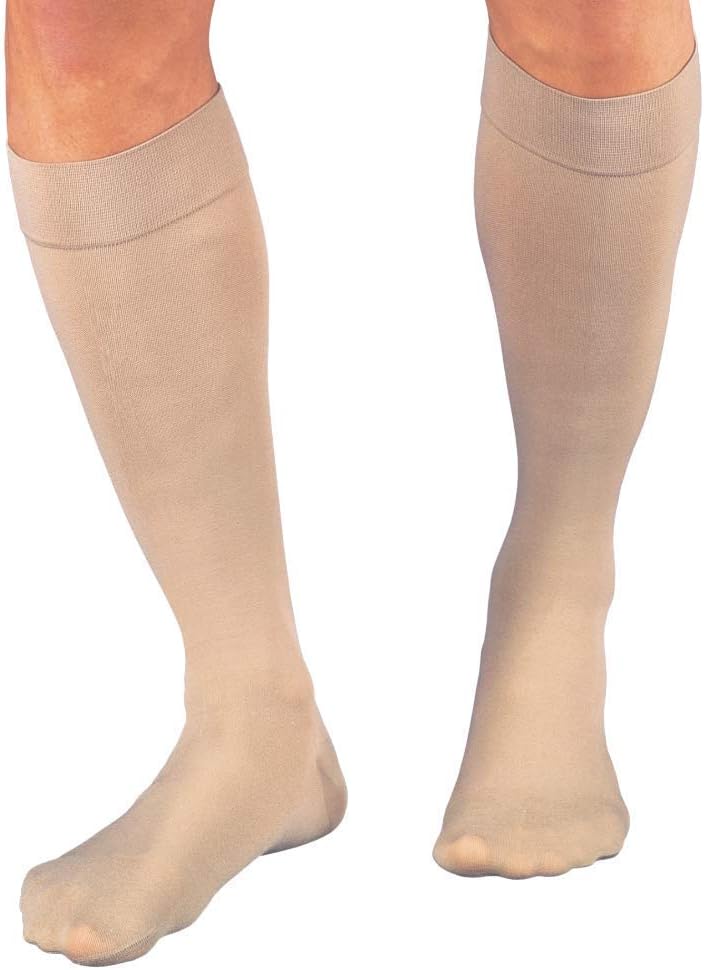
JOBST Relief Knee High 20-30 mmHg, Closed Toe
This is the JOBST most people are actually looking for. Relief is the brand's workhorse line, and this is the firm 20-30 mmHg knee high in a closed toe, with over twelve hundred owner reviews behind it, which makes it by a distance the best-evidenced product JOBST sells on Amazon. The construction is plain and heavy in the way medical compression tends to be, and that is the point: it holds its rated pressure across months rather than softening after a few weeks like cheaper stockings do. The silicone dot band keeps it up without needing a punishing cuff. Be realistic about two things. It looks unmistakably medical, so it lives under trousers. And at this compression level with a closed toe, getting it on is genuine work, which is the single best argument for the open toe version below.
Pros
- Over twelve hundred owner reviews, the strongest record in the JOBST range
- Holds its rated compression far longer than budget stockings
- Silicone dot band prevents sliding without an over-tight cuff
- Full size and length grading including petite
Cons
- Unmistakably medical in appearance
- Closed toe at 20-30 mmHg is hard work to don
- Heavier fabric that runs warm
Best for everyday wear
JOBST Relief Knee High 15-20 mmHg
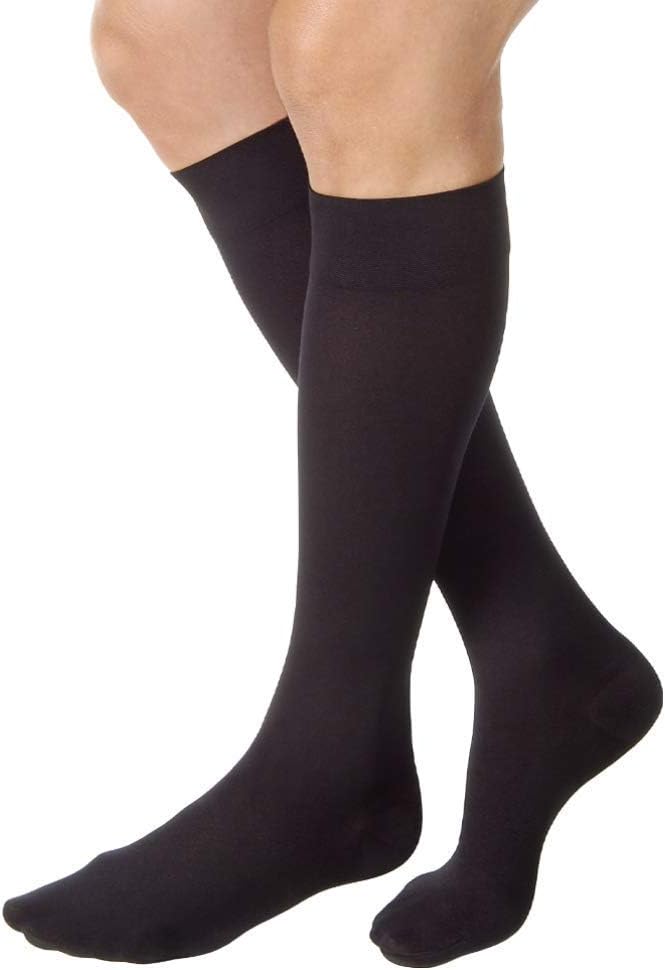
Most people buying JOBST do not need 20-30 mmHg, and this is the pair to start with if nobody has told you otherwise. At 15-20 mmHg it covers standing all day, travel, mild evening swelling and general heaviness, and it is dramatically easier to get on than the firm version, which matters more than it sounds: the most common reason compression fails someone is that it ends up in a drawer. Same Relief construction and the same reliable JOBST sizing, at a lower price than the firm line. With over two hundred and fifty reviews it is well evidenced. The honest limit is that if you have visible varicose veins or persistent swelling, this is probably a step below what you need, and the firm version above is the right pick.
Pros
- The right level for standing, travel and everyday swelling
- Far easier to put on than 20-30 mmHg
- Cheapest JOBST here
- Over two hundred and fifty owner reviews
Cons
- Not firm enough for diagnosed venous conditions
- Still plain and medical looking
- Fewer colour options than the Opaque line
Easiest to put on
JOBST Relief Knee High 20-30 mmHg, Open Toe
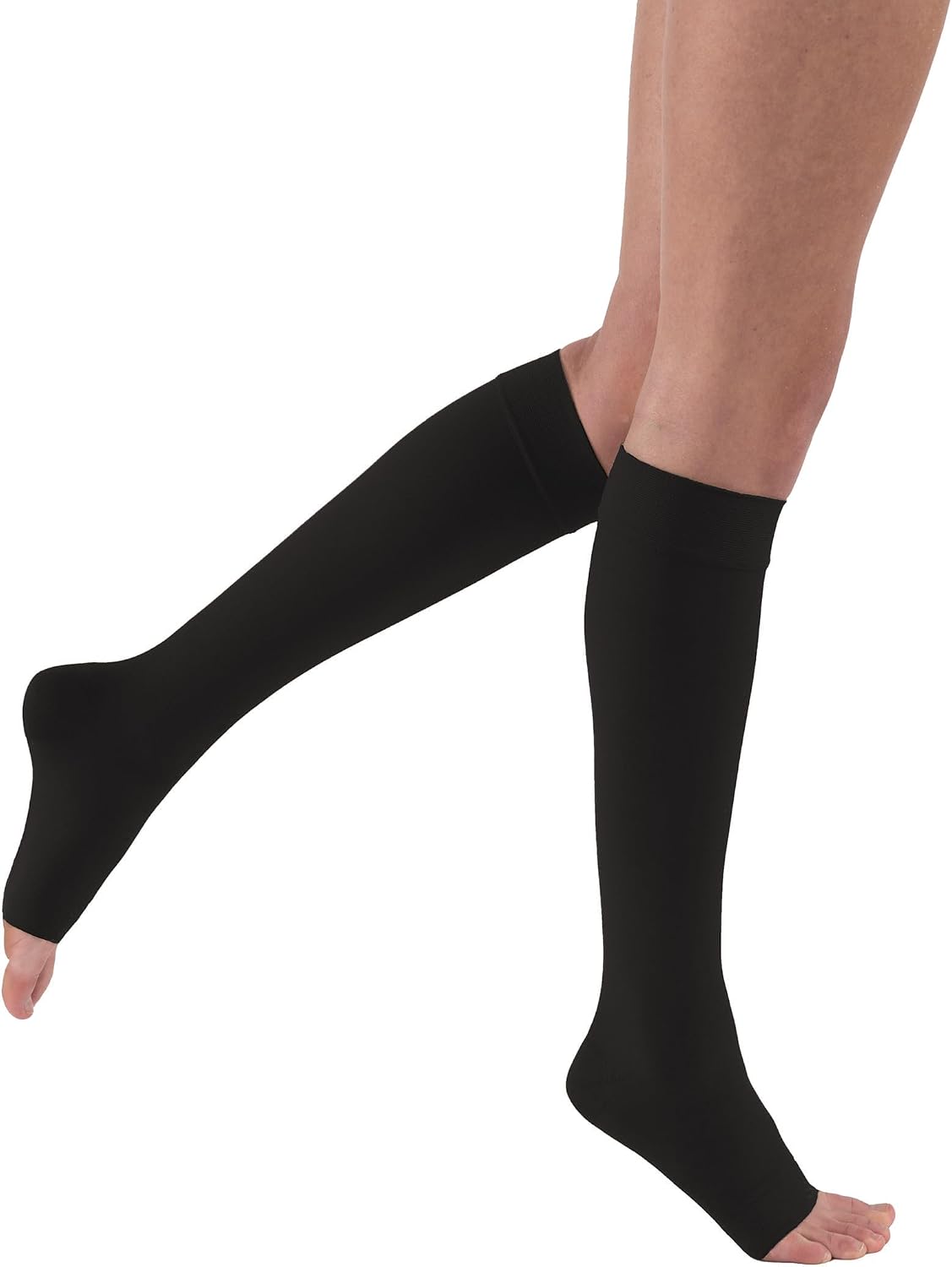
Same firm 20-30 mmHg Relief stocking as our top pick, with the toe left open, and for a lot of people that single change is what makes firm compression sustainable. An open toe lets you use a slip aid and grip the fabric properly, which turns a five minute wrestle into something closer to thirty seconds. It also runs noticeably cooler, and it suits anyone with toe sensitivity, nail problems, or a wide forefoot that a compression toe box pinches. The compression is identical to the closed toe version, since the therapeutic pressure is applied at the ankle and up the calf, not at the toes. The listing we verified is a size variant with a small review count, which reflects Amazon splitting counts across sizes rather than the product's standing.
Pros
- Substantially easier to don than closed toe at this compression level
- Works with a slip aid or donning frame
- Cooler, and better for toe sensitivity or a wide forefoot
- Same silicone dot band and same rated compression
Cons
- Exposed toes are not to everyone's taste in winter
- Small review count on the specific size variant
- Same medical appearance as the rest of the Relief line
Best if veins extend above the knee
JOBST Relief Thigh High 20-30 mmHg, Silicone Band
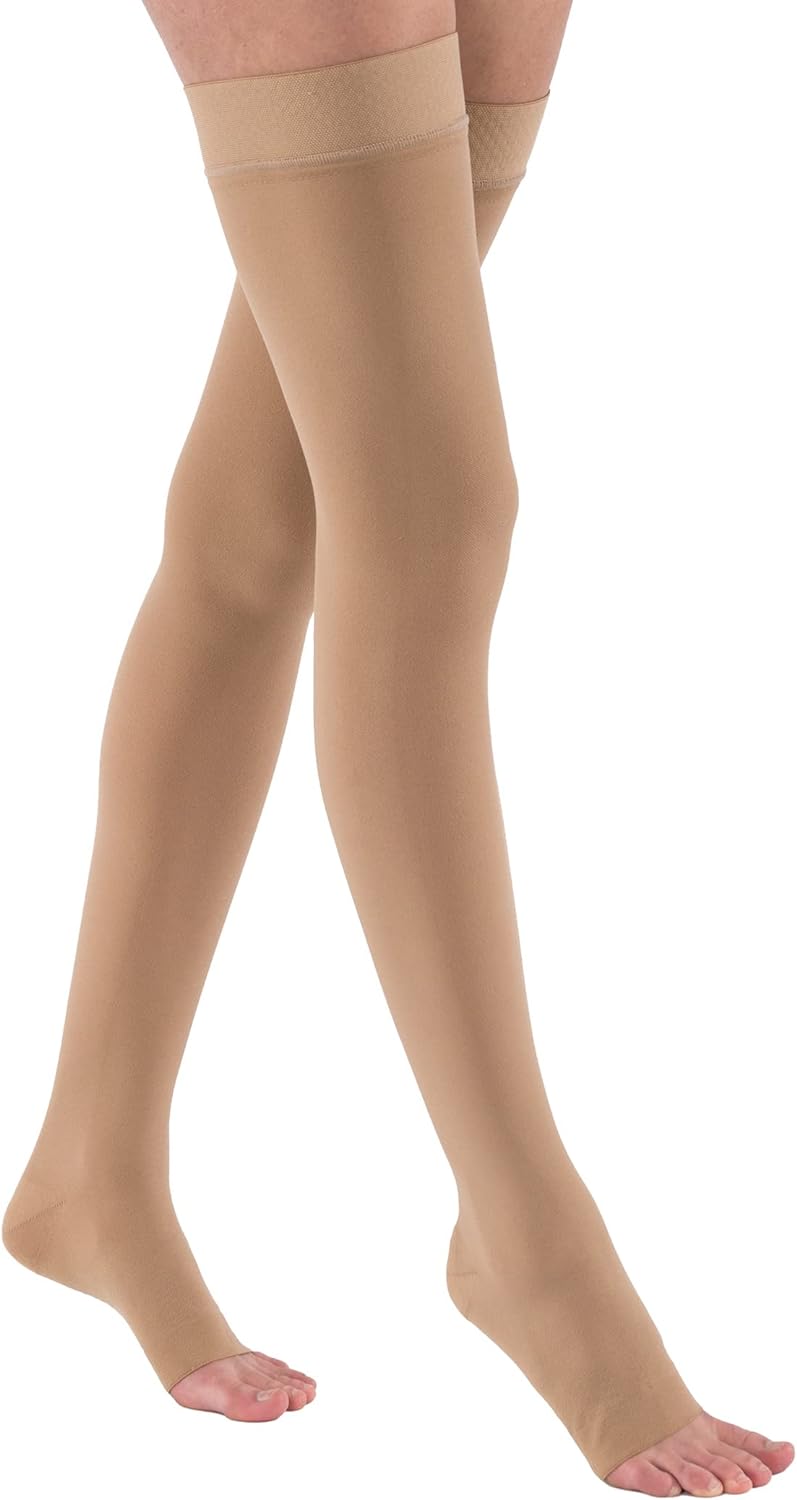
Buy this only if you actually need coverage above the knee, which is a smaller group than the thigh high market implies. Most swelling and most visible varicose veins sit below the knee, and a knee high is easier to wear, easier to keep up and cheaper. If your symptoms do extend into the thigh, this is the best-executed answer in the JOBST range. The continuous silicone band is the most effective anti-slide solution we have found in any brand, holding position without the cuff needing to bite, which is the usual compromise. With over a thousand reviews it is properly evidenced. The two caveats are the ones that apply to all thigh highs: it is meaningfully harder to don than a knee high, and lotion or oil on the thigh will defeat the silicone entirely.
Pros
- The most effective anti-slide band we have tested
- Over a thousand owner reviews
- Covers thigh veins a knee high cannot reach
- Open toe version makes a long stocking manageable
Cons
- Most people do not need thigh coverage
- Harder to don and keep up than any knee high
- Silicone can irritate sensitive skin, and lotion defeats it
Best if you do not want it to look medical
JOBST Opaque Knee High 15-20 mmHg
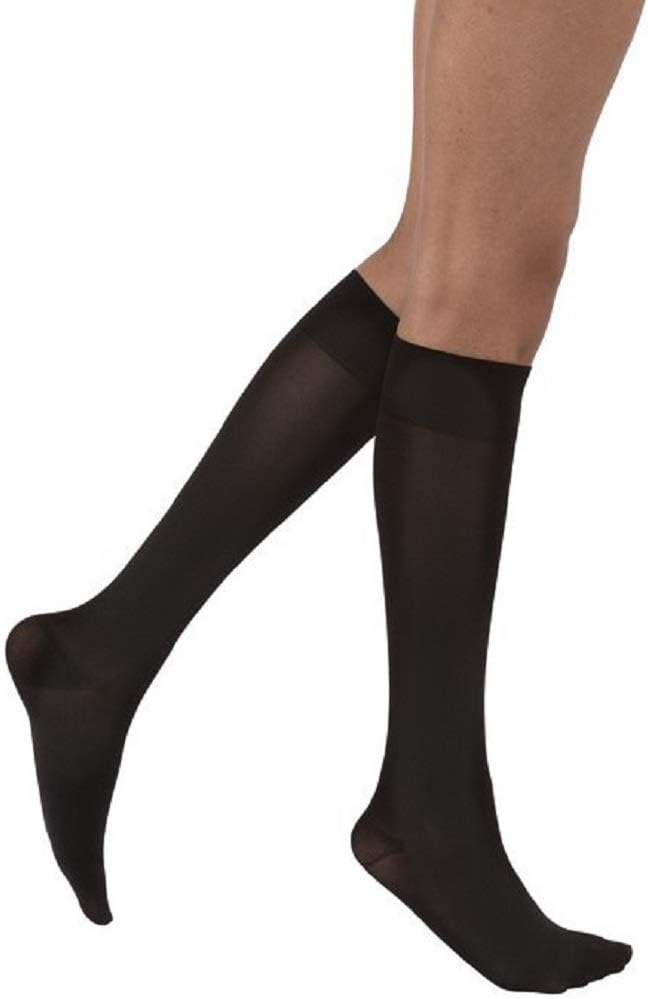
The Opaque line exists for a reason the clinical brands usually ignore: appearance drives whether people keep wearing compression. This is a knit designed to read as normal opaque hosiery rather than medical wear, at a moderate 15-20 mmHg, and it is the JOBST to choose if the stockings will be visible with a skirt or a dress. The trade against Relief is real but narrow. The finer knit is slightly less hard-wearing, it costs more for the same compression level, and the review count here is smaller. What you get back is a stocking you are willing to be seen in, which for a lot of people is the difference between daily wear and occasional wear. If you need firm 20-30 mmHg and also want the look, JOBST does make Opaque at that level, though the Amazon listings for it are thinner.
Pros
- Looks like normal hosiery rather than medical compression
- Moderate 15-20 mmHg suits everyday standing and travel
- Proper JOBST sizing and construction underneath
Cons
- More expensive than Relief for the same compression
- Finer knit is less hard-wearing
- Smaller review base than the Relief line
Also worth considering
Strong, well-reviewed products that just missed our ranked list - worth a look if the picks above aren't quite right for you.
- JOBST Opaque Knee High with SoftFit Technology Band, 15-20 mmHg - The Opaque line with a softer top band, worth a look if a standard cuff marks your leg or feels tight at the top. Rated well but on a thinner review base, which is why it sits here rather than in the ranked list.
- Truform 20-30 mmHg Knee High - The honest value comparison. Same firm compression, a wider size range, over eight thousand reviews, and a fraction of the price. Plainer and warmer than JOBST, but if cost is what stops you wearing compression consistently, start here instead.
- Sigvaris DYNAVEN Women's Calf-High 20-30 mmHg - The other clinical name you will be offered at a vein clinic. Better made than JOBST Relief and priced accordingly, with an open toe design that is the easiest of any firm stocking to get on.
Frequently asked questions
What is the difference between JOBST Relief, Opaque and UltraSheer?
They differ in fabric, not in mechanism. Relief is the plain, hard-wearing everyday line and the best value. Opaque is a knit that reads as normal hosiery rather than medical wear. UltraSheer is a fine, near-transparent knit for wearing with dresses and skirts. All three come in the same graduated compression levels, so pick the line on appearance and durability, then pick the mmHg separately.
Is JOBST worth the price over a budget brand?
For consistency between pairs, yes. JOBST has decades of clinical use and its sizing and compression hold up predictably, which matters if you depend on the stocking. But Truform delivers the same 20-30 mmHg with a wider size range for meaningfully less money, and if cost is what stops you wearing compression consistently, the cheaper stocking you actually wear beats the better one you ration.
What does the silicone dot band on JOBST Relief do?
It stops the stocking sliding down without needing the cuff to be brutally tight, which is the usual trade at 20-30 mmHg. Two practical notes: it can irritate genuinely sensitive skin, and body lotion or oil on the leg defeats the silicone completely. If a band that used to work suddenly stops holding, moisturiser is very often the reason.
Should I get open toe or closed toe?
Open toe is significantly easier to put on because you can use a slip aid and get real purchase on the fabric, and it runs cooler. Closed toe feels like a normal sock and is warmer. The compression is delivered at the ankle and up the calf either way, so neither is more effective. At 20-30 mmHg, donning difficulty is a real reason to choose open toe.
How do I size JOBST compression socks?
On leg measurements, not shoe size. You need ankle circumference at the narrowest point and calf circumference at the widest, taken first thing in the morning before swelling develops. JOBST also splits several lines into full-calf and petite lengths, so check length as well as circumference, since a stocking that bunches behind the knee creates a pressure point exactly where you do not want one.