Best Compression Socks for Men (2026): Calf Width and mmHg
Stand ten hours on concrete and calf width matters more than brand. Men's compression socks compared on fit, merino versus nylon and mmHg.
Most compression sock guides aimed at men either treat them as gym recovery gear or as medical equipment, and neither framing is much use if you are buying because you stand on concrete for ten hours or because your ankles are swelling by evening.
Here is the practical version, compared across four brands on the same five criteria.
Our picks at a glance
- Best overall: Sockwell Men’s Circulator, merino at the 15-20 mmHg level most men actually need
- Best cheap 15-20: JOBST Relief, clinical construction and a proper length and width sizing grid
- Best firm option: Sockwell Pulse OTC, merino, over-the-calf, works under boots or dress shoes
- Best open toe: Doc Miller, for wide feet or anyone who finds a compression toe box hot
- Best value: Run Forever, so a three pair rotation is affordable
The calf problem is worse for men
This is the single most useful thing on this page.
The measurement that decides whether a compression sock works is calf circumference. Men with developed calves, whether from the gym, from cycling, or from simply standing all day for years, routinely exceed the top of standard size bands. When that happens the sock applies its tightest pressure at the widest part of the calf instead of at the ankle. You get a red trench below the knee, it feels like it is cutting in, and the natural conclusion is that you bought too much compression.
That conclusion is wrong, and acting on it makes things worse. Stepping down from 20-30 to 15-20 mmHg does not fix a circumference problem. You need a larger size or a wider-cut sock at the same pressure.
Here is the part nobody tells you, and it is why we built the table below.
Most of these brands will not sell you on that measurement. We checked what each manufacturer publishes on its own product page. Sockwell, which makes two of our five picks including the top one, sizes purely by shoe size: M/L is men’s 7-10, L/XL is 10.5-13, XXL is 13.5-16, and calf circumference appears nowhere. Run Forever publishes its chart only as an image. JOBST at least ships dedicated Full calf sizes, which is an acknowledgement of the problem even though the circumference figures are not on the product page.
The one brand in this lineup that tells you to measure is the cheapest: Doc Miller publishes a calf range of 11-18 inches and an ankle range of 7-10 inches, with instructions to measure the widest part of the calf and the narrowest part of the ankle.
That is an uncomfortable finding for a page whose top pick is a Sockwell, and we are leaving it visible rather than quietly dropping the column. The Circulator is still the sock we would hand most men, because merino over a ten-hour shift is worth a great deal and Sockwell’s shoe-size bands do fit the majority. But if your calves are the reason previous socks failed, buy from a brand that will take the measurement, and measure first thing in the morning before any swelling. We checked 19 brands’ sizing pages for exactly this; only three publish a calf chart you can read.
Merino or nylon
The material decision splits on how long you wear them.
Merino, as in both Sockwell picks (the moderate Circulator and the firm Pulse), is worth the money for a full working day. It regulates temperature and resists odour, and inside a work boot for ten hours that is the difference between a sock you forget about and one you cannot wait to remove. It costs more and needs air drying. Sockwell runs several merino models and the differences between them are not obvious from the names, so we compared the whole Sockwell range separately.
If you are buying for a woman rather than for yourself, calf sizing and the styling range differ enough that our women’s roundup is the more useful page.
Nylon, as in the Run Forever, is cheapest, dries fastest and runs hottest. Perfectly fine for a flight, a gym session, or as the bulk of a rotation.
Heavier medical knits, as in the Truform, sit apart: built for consistent compression and sizing rather than for comfort. Under trousers at work that is a fair trade.
Over-the-calf or knee high
Men’s compression comes in both, and the difference is practical rather than therapeutic.
An over-the-calf cut like the Pulse sits higher, which means it stays put under trousers without constant adjusting. If you wear a suit or work trousers, this is the more comfortable arrangement by some margin.
A knee high sits just below the knee bend. It is cooler and slightly easier to don, and it is what most medical stockings are.
Neither delivers more compression. The rated pressure is at the ankle in both cases.
Compression level
For most men reading this, 15-20 mmHg is the right answer: standing all day, travel, recovery after training, general evening heaviness.
20-30 mmHg is the step up for visible varicose veins, persistent swelling that does not resolve overnight, or post-surgical recovery, and it is usually chosen on clinical advice rather than because a shift is long.
So the list leads with 15-20 mmHg, and the two picks at the top are both at that level. The three firm options below them are there for the people who genuinely need the step up, not as the default. If you are unsure, our mmHg guide explains the difference, and the short version is that a moderate sock you actually wear beats a firm one you fight with and abandon.
Buy three pairs
Compression comes from elastane, and elastane degrades with every wash and every stretch. Manufacturers put the useful life at roughly three to six months of regular wear.
Most good compression socks also need air drying rather than a tumble dryer, so one pair cannot cover consecutive days even if you wash daily. Three pairs in rotation solves that and extends the calendar life of each, because the elastane gets time to recover.
It is also why a mixed rotation makes sense: one merino pair for the longest days, two cheaper pairs for everything else.
If your feet hurt rather than your legs
Worth separating the symptoms before you spend anything.
Aching calves, heavy legs, swollen ankles by evening is a circulation pattern, and compression is the right tool.
Visibly bulging or ropey veins is a different matter from tired legs, and the socks on this page are not built for it. Varicose veins are commonly assumed to be a women’s problem and are not; the firm 20-30 mmHg field is covered in our varicose vein stocking guide.
Sore feet, arches and heels is a footwear problem, and the relevant pages are the best men’s shoes for standing all day and insoles.
Both, on a hard floor, in one spot usually means an anti-fatigue mat will do more per pound than either.
A note on scope
We are independent reviewers, not clinicians. If you have diabetes, peripheral arterial disease, or a diagnosed venous condition, the compression level should come from a clinician rather than a roundup.
What the manufacturers actually publish
Every figure below is quoted from the manufacturer's own page, linked in the cell. Where a cell reads "Not published", that brand does not state it anywhere on its product page as of 2026-09-07.
How we test
Every pick is scored on the same five criteria and cross-checked against real owner feedback - so the ranking reflects how a product holds up over a full shift, not its spec sheet.
Support
Whether graduated compression actually matches its stated mmHg rating, or, for mats and insoles, how much load it takes off your legs.
Comfort
All-day wearability: no bite at the cuff, no hotspots, breathable enough for a full shift.
Durability
Whether it holds compression or loft after repeated washing and months of daily use.
Fit
Size range, calf-width options, and how honest the sizing chart is against real owner reports.
Value
What you get for the price, including cost per wear once durability is accounted for.
Best overall
Sockwell Men's Circulator Moderate Graduated Compression
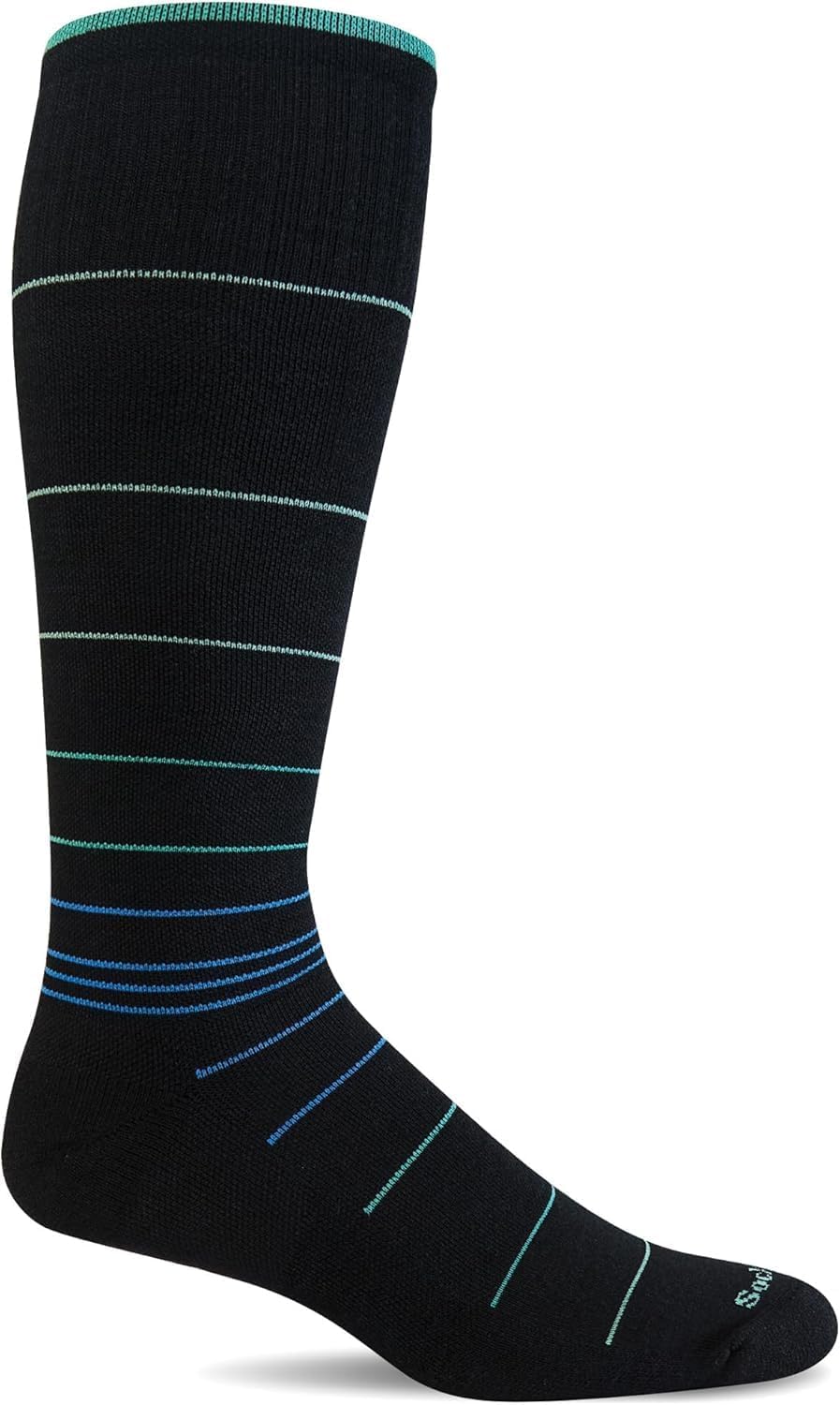
This is the pair most men should start with, and until now this page did not offer it. At 15-20 mmHg it sits at the level that suits standing all day, travel and general end-of-day heaviness, rather than the firmer tier meant for diagnosed conditions. It is built on the same merino blend as the firm Sockwells, which is what makes it wearable for a full day: nylon inside a work boot for ten hours gets hot and holds odour, and merino does not. Moderate compression is also far easier to pull on before an early start, and that matters more than it sounds, because the most common reason compression fails someone is that it ends up in a drawer. With over eighteen hundred owner reviews and an Amazon's Choice badge it is the best-evidenced men's sock here. The trade-offs are the usual Sockwell ones: it is expensive, it needs air drying, and if you have been told to wear 20-30 mmHg this is not it.
Pros
- 15-20 mmHg is the level most men standing all day actually need
- Merino handles a ten hour shift without heat or odour
- Over eighteen hundred owner reviews, the strongest record on this page
- Far easier to get on than the firm Sockwells
Cons
- Premium price, and you want three pairs in rotation
- Air dry only
- Not enough if a clinician has specified 20-30 mmHg
Best medical-grade at everyday strength
JOBST Relief Knee High 15-20 mmHg
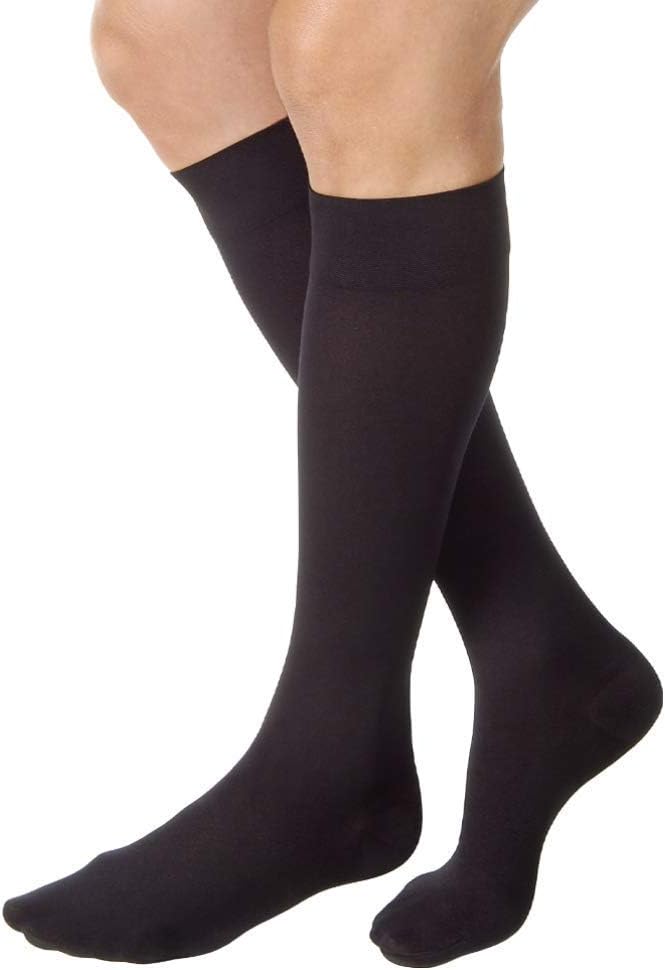
The alternative to the Sockwell if you want clinical construction without paying merino prices, and the plain black is unremarkable enough to disappear under work trousers. JOBST is a name clinicians recognise and Relief is its accessible line, so you get proper medical grading at the everyday 15-20 mmHg level rather than the firm tier. Sizing is on leg measurements with a full length and width grid, which is genuinely useful for men whose calves fall between standard sizes. It is cheaper than anything else here at this compression level. What you give up is material: it is a synthetic knit that runs warmer than merino over a long shift, and the look is functional rather than something you would wear deliberately.
Pros
- Clinical construction at the everyday 15-20 mmHg level
- Full length and width sizing grid, useful for in-between calves
- Cheapest 15-20 mmHg option here
- Plain black disappears under work trousers
Cons
- Runs warmer than merino across a full day
- Purely functional appearance
- Not the pick if you need 20-30 mmHg
Best firm option
Sockwell Men's Pulse OTC Firm Graduated Compression
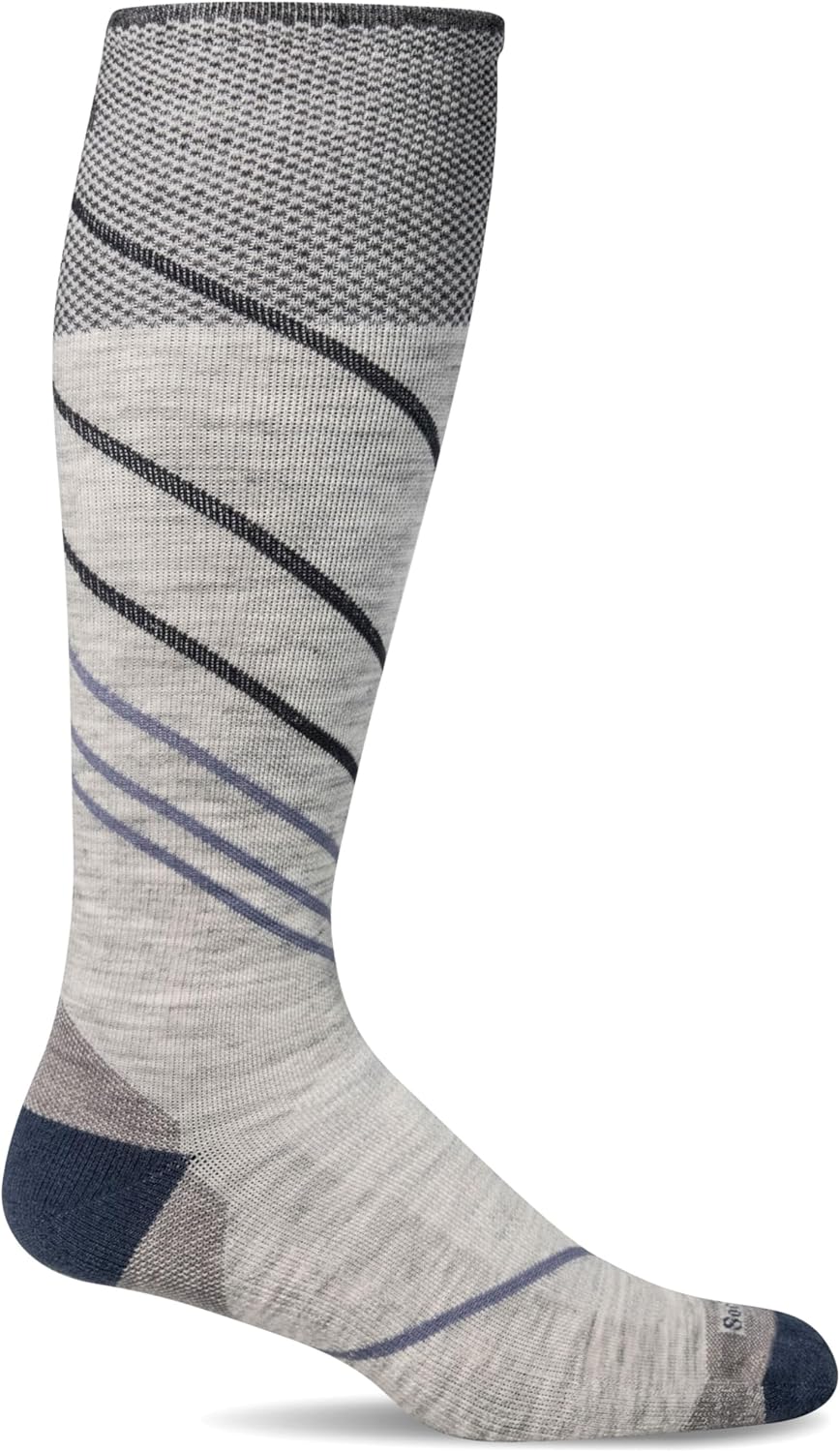
The Pulse is the pair we would hand most men first. It is an over-the-calf firm graduated sock built on Sockwell's merino blend, and that material choice is what separates it from the field. Firm compression traps heat, and a nylon sock inside a work boot or a dress shoe for ten hours gets unpleasant in a way merino simply does not. The over-the-calf cut is the other real advantage: it sits high enough to stay put under trousers without the constant hitching that a shorter sock demands. The knit is finer than Sockwell's Elevation, so it works under a dress shoe as well as a boot, which widens where you can actually wear it. It is expensive and it needs air drying, which in practice means owning three pairs. The colour range is plainer than the women's line, though that is arguably the point here.
Pros
- Merino blend handles long days without heat or odour
- Over-the-calf cut stays put under trousers
- Finer knit works under dress shoes, not just boots
- Strong review base for a premium sock
Cons
- Premium price, and you want three pairs
- Air dry only
- Plain colourways compared with the women's range
Best value
Run Forever Compression Socks 20-30 mmHg
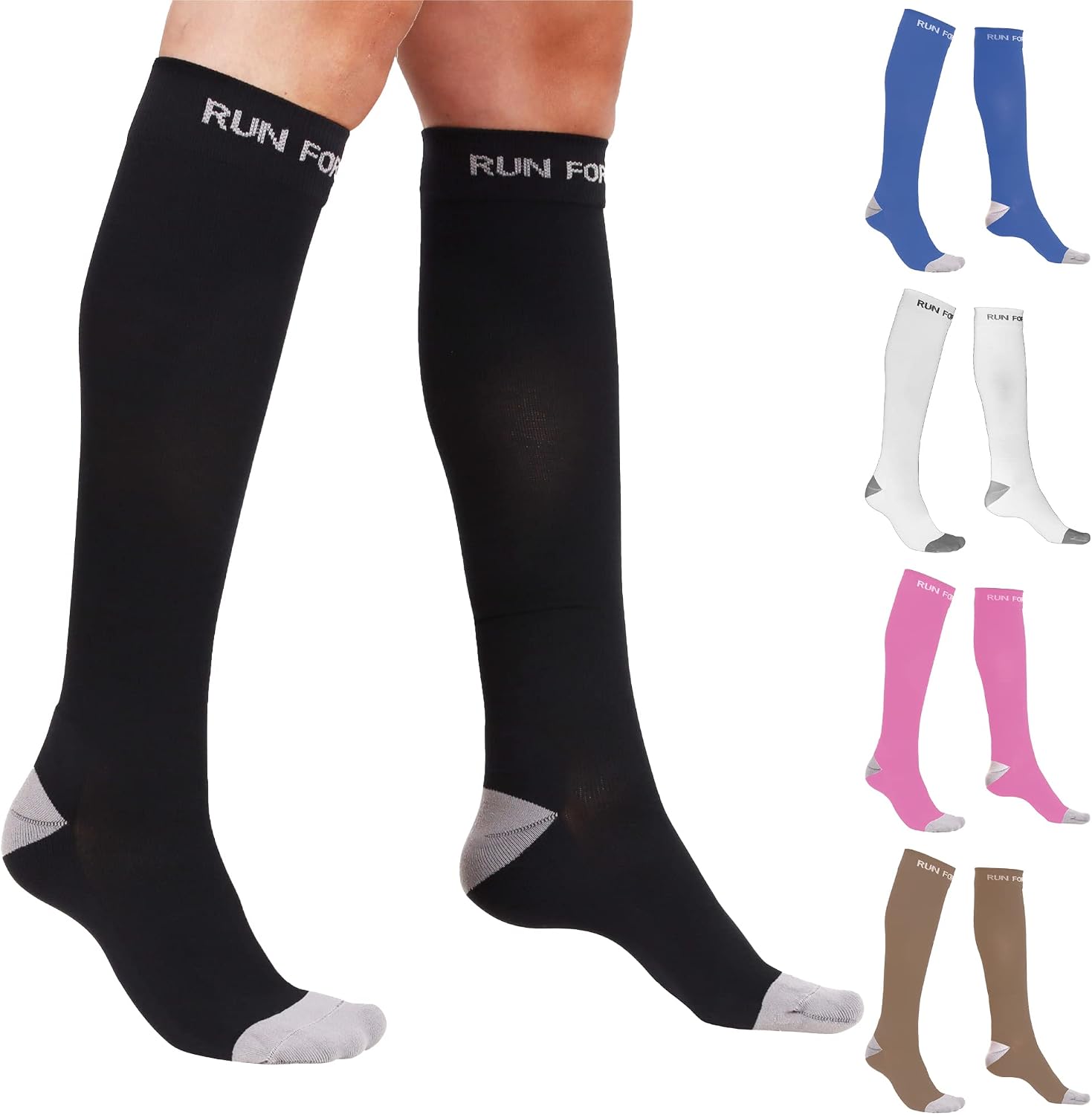
The straightforward case for the Run Forever is that firm compression is expensive and this is not. It offers a stated 20-30 mmHg knee-high graduated compression at a fraction of what Sockwell costs, which makes the three-pair rotation that compression socks genuinely require an affordable proposition rather than an aspirational one. The unisex sizing runs reasonably generous, so it accommodates a wider calf than the Sockwell will. What you give up is material. The nylon blend runs hot and holds odour across a long day in a way merino does not, and the compression will fade sooner. Our honest recommendation is to run these as the bulk of a rotation alongside one better pair rather than as your only socks.
Pros
- Firm 20-30 mmHg at a price that makes a rotation realistic
- Generous unisex sizing accommodates wider calves
- Cheap enough to replace on schedule
Cons
- Nylon runs hot and holds odour
- Compression fades sooner than premium pairs
- Basic construction and limited colours
Best open toe
Doc Miller Open Toe Compression Socks 20-30 mmHg
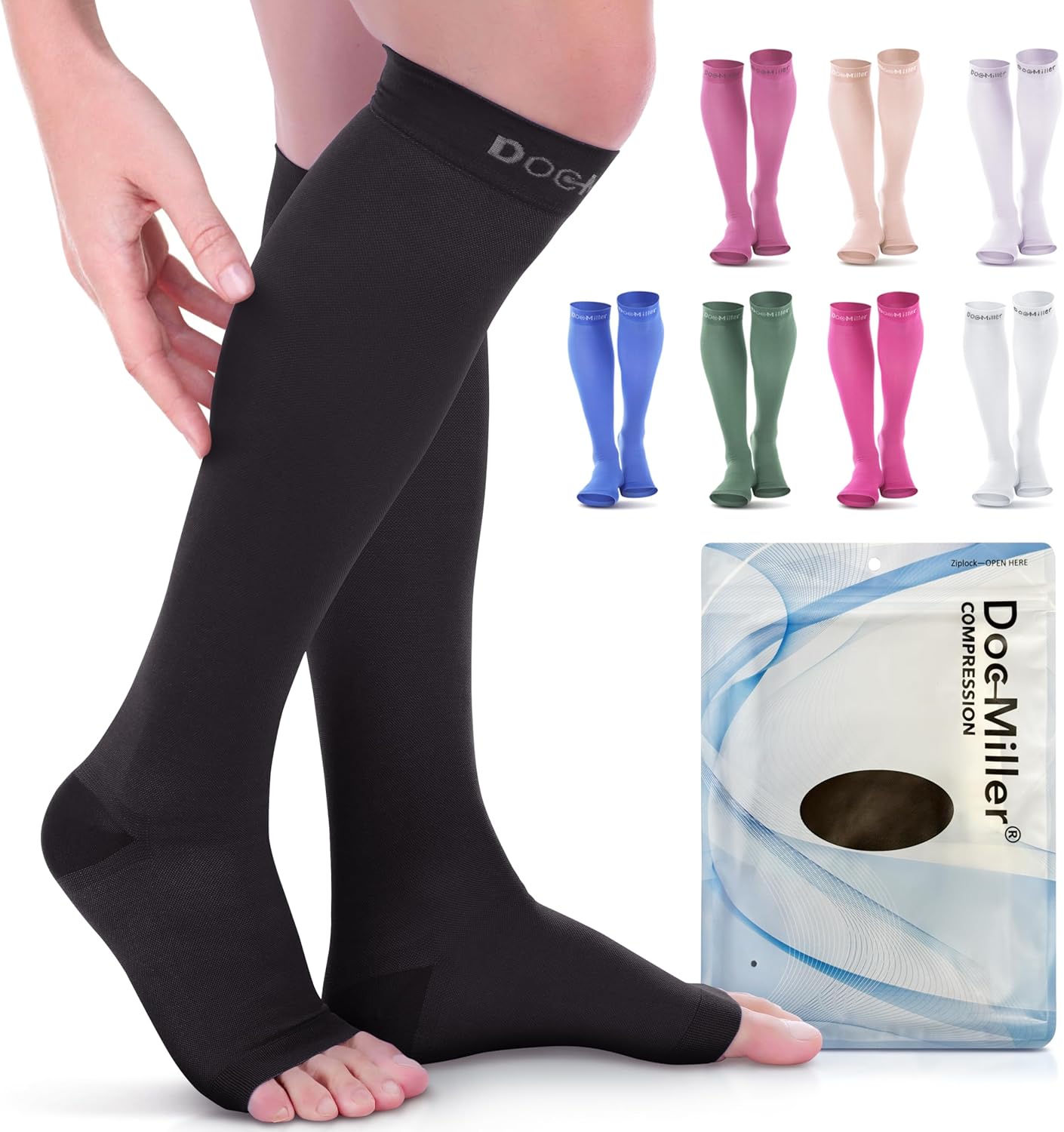
Wide feet and firm compression are an awkward combination, because a 20-30 mmHg closed toe box squeezes exactly the part of a broad forefoot that is already tight in a work boot. This footless sleeve sidesteps that entirely: graduated compression from ankle to knee, foot left free, and considerably easier to pull on than any closed toe sock at this pressure. With over four hundred reviews it is well evidenced for a value brand. Two honest limitations. It offers no support to the foot itself, so if your ankles rather than your calves are the problem, a closed toe pair does more. And it sits at 4.1 stars, the lowest rating on this page, with sizing consistency between colourways the recurring criticism.
Pros
- Open toe suits wide feet that a compression toe box pinches
- Much easier to don than closed toe at 20-30 mmHg
- Over four hundred owner reviews
Cons
- Rated 4.1 stars, lowest here
- No support for the foot itself
- Sizing varies between colourways
Also worth considering
Strong, well-reviewed products that just missed our ranked list - worth a look if the picks above aren't quite right for you.
- Sockwell Men's Elevation Firm 20-30 mmHg - The chunkier merino knee high if you need the firm tier. Longest review history of any Sockwell here, and better suited to a boot than a dress shoe.
- Truform 20-30 mmHg Knee High - The budget firm option, with an enormous review record behind it. Plain and medical looking, and it runs warm, but the compression is honestly graded.
- Sockwell Women's Elevation Firm 20-30 mmHg - Listed deliberately: the women's Elevation is graded narrower through the calf than the men's, so it suits a slimmer leg that the men's line leaves loose. Note the limit shown in the table above, though - Sockwell sizes this on shoe size and publishes no calf figure, so you cannot confirm the fit before buying. Match it to your shoe size and treat the calf as the risk.
Frequently asked questions
Are men's and women's compression socks different?
Functionally they are the same product with different size grading and colourways. Men's versions are cut for a larger foot relative to calf circumference and tend to come in plainer colours. If a women's sock fits your measurements, it works identically. Buy on ankle and calf circumference rather than on the label.
What compression level should men buy?
15-20 mmHg for standing all day, travel, recovery after exercise, and general end-of-day heaviness. 20-30 mmHg for visible varicose veins, persistent swelling, or post-surgical recovery, usually on clinical advice. Athletic recovery does not require the firmer level despite how it is often marketed.
Why do compression socks cut into my calves?
Muscular calves are the most common cause, and it is a fit problem rather than a compression level problem. Men with developed calves frequently exceed standard size bands, so the sock applies its tightest pressure at the widest point instead of at the ankle. The fix is a larger size or a wide calf model at the same mmHg, not a weaker sock.
Can I wear compression socks every day?
Yes. Daily wear from morning until bedtime is the normal pattern, and the benefit comes from being upright with gravity working against you. They are generally not worn overnight unless a clinician has advised it.
Do compression socks help with running?
The evidence for performance improvement is weak, but the evidence for perceived recovery is better, and plenty of runners find their calves feel less trashed the day after a hard session. If that is your reason for buying, 15-20 mmHg is the level to get, and you do not need medical-grade compression.