The Best Insoles for Standing All Day (2026)
Work insoles from Dr. Scholl's, Superfeet and Timberland PRO compared: gel versus structured arch support, wide feet, and when an insole cannot fix the shoe.
An insole is the cheapest thing you can change about how your feet feel at hour ten, and it is also the most oversold. It can redistribute pressure and hold your arch up. It cannot fix a shoe that is the wrong shape, and it cannot rescue a midsole that has already collapsed.
With that established, here are five that are worth the money, compared on the same five criteria.
Our picks at a glance
- Best overall: Dr. Scholl’s Work All-Day, men’s, with an exceptional sixty thousand review evidence base
- Best for arch support and wide feet: Superfeet Wide-Fit, firm structure rather than cushioning
- Best for women’s work shoes: Dr. Scholl’s Work All-Day, women’s
- Best if you cover distance: Dr. Scholl’s Walk Longer
- Best for work boots: Timberland PRO Anti-Fatigue, built for enclosed footwear
Cushioning or structure: the decision that matters
Nearly every insole falls into one of two camps, and picking the wrong camp is why people conclude insoles do not work.
Cushioned insoles, like the Dr. Scholl’s here, use gel and foam to absorb impact and spread pressure. They feel immediately better in the shop. They suit hard floors, heel pain and people who move around.
Structured insoles, like the Superfeet, use a firm shell to hold your arch in position so it does not flatten across a shift. They feel odd for the first week. They suit aching arches, flat feet and standing still for long periods.
The rule of thumb: if your heels hurt, cushion. If your arches ache, structure. If both, a structured insole with some forefoot padding is the compromise, and a cushioned insole in a shoe that already has good arch shape gets you close.
Cushioning is also what fails under sustained static load. Standing still for ten hours compresses foam and gel far faster than walking does, which is the counterintuitive reason a plusher insole is often the wrong answer for a stationary job.
Trim-to-fit or sized
Trim-to-fit insoles come oversized with a printed cutting guide. One product covers a wide size range, they fit most closed shoes and work boots, and you do not need to know anything about orthotic sizing. The downside is that the arch support is positioned for an average foot of that length rather than for yours.
Sized insoles like Superfeet come pre-moulded in discrete sizes. The support lands where it should, but you need to buy the right size and you need a shoe with a removable factory insole to make room. Drop a sized insole on top of an existing one and you will have squeezed the shoe by several millimetres.
One important exception: professional clogs with a fixed contoured footbed, such as the Dansko in our shoes roundup, generally will not accept an aftermarket insole at all. The footbed is the feature you paid for.
Wide feet
Most aftermarket insoles taper noticeably toward the forefoot, because they are designed around the average shoe last. If you have a wide forefoot, that taper creates pressure at exactly the point that already hurts.
This is why the Superfeet Wide-Fit is on this list even though it is the most expensive option. Cut for 3E to 6E, it is one of relatively few insoles that does not squeeze a wide foot, and for the people this affects it outperforms a technically better insole in the wrong width.
Men’s and women’s are not interchangeable
It is tempting to buy a men’s insole and trim it down, and it does not work well.
The arch sits at a different point relative to overall foot length in men’s and women’s sizing, so a trimmed men’s insole puts its support slightly behind where a woman’s arch actually is. Close enough to feel supportive for an hour, wrong enough to be uncomfortable across a shift. Buy the version cut for the sizing you wear.
Replace them sooner than you expect
Both foam and gel compress permanently, and the failure is gradual, which is why it goes unnoticed. For someone standing full time, especially on concrete, six months is realistic. Heavier users get less.
The tell is timing rather than appearance. If your feet start hurting at hour four when they used to make it to hour eight, the insole is finished even though it looks fine. The structured Superfeet shell is the exception here and will outlast the others comfortably.
An insole is one of four levers
Be honest with yourself about which problem you actually have, because they have different fixes:
- The floor. If you stay in roughly one spot, an anti-fatigue mat does more per pound than anything else on this page, and if that spot is a sink or a stove, size matters more than brand, which is why kitchen mats get their own page.
- The shoe. If your shoes are over a year old and you stand full time, replace them before buying insoles. A collapsed midsole cannot be patched. Our roundups for women and men cover this.
- The insole, which is the right lever when the shoe is decent but under-supported.
- Your circulation. If your feet are fine but your calves ache and your ankles swell, none of the above helps and compression socks are what you want, for the reasons set out in why your feet and legs hurt after standing all day.
If you are not sure which of the four applies to you, why your feet hurt after standing all day works through the symptom patterns, and our standing all day at work guide puts the four levers in the order worth tackling them.
Buying an insole to solve a circulation problem, or compression socks to solve an arch problem, is the most common wasted purchase in this whole category.
How we test
Every pick is scored on the same five criteria and cross-checked against real owner feedback - so the ranking reflects how a product holds up over a full shift, not its spec sheet.
Support
Whether graduated compression actually matches its stated mmHg rating, or, for mats and insoles, how much load it takes off your legs.
Comfort
All-day wearability: no bite at the cuff, no hotspots, breathable enough for a full shift.
Durability
Whether it holds compression or loft after repeated washing and months of daily use.
Fit
Size range, calf-width options, and how honest the sizing chart is against real owner reports.
Value
What you get for the price, including cost per wear once durability is accounted for.
Best overall
Dr. Scholl's Work All-Day Superior Comfort Insoles (Men's)
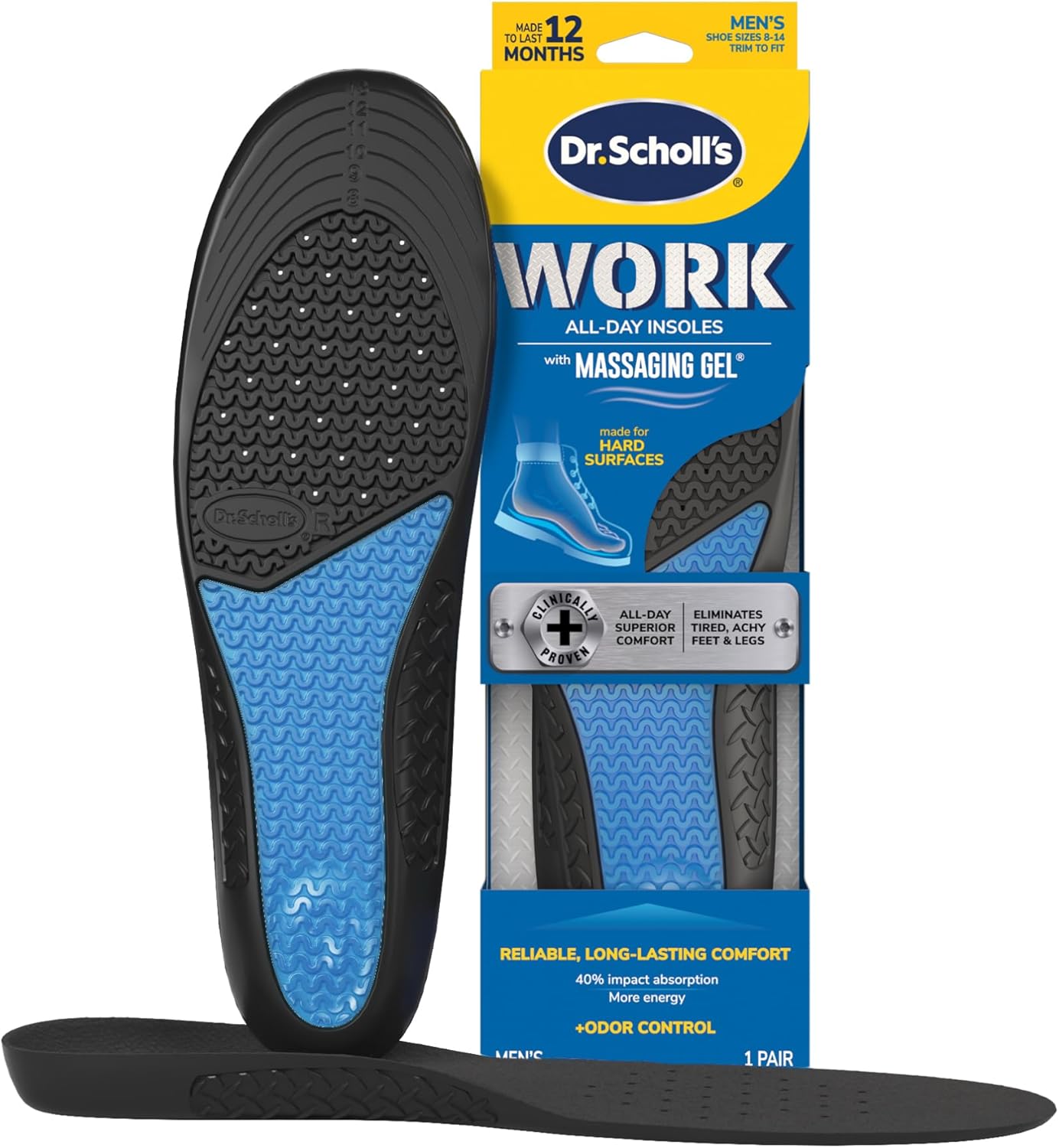
With over sixty thousand owner reviews, this is one of the most thoroughly evidenced products in any category we cover, and it is the insole we would suggest most people try first. It is built specifically for standing rather than adapted from a running insole: massaging gel through the heel and forefoot to take the sting out of hard floors, with reinforced arch support that does not collapse the way a plain foam insert does. The trim-to-fit design is a genuine practical advantage, because it means one product fits work boots, trainers and most closed work shoes without you needing to know your orthotic size. It is not a corrective orthotic and does not pretend to be. Durability is the honest weak point: gel compresses, and for someone on concrete full time, six months is realistic rather than a year.
Pros
- Over sixty thousand owner reviews, exceptional evidence base
- Designed for standing rather than adapted from a running insole
- Trim to fit works in boots, trainers and work shoes
- Inexpensive enough to replace on schedule
Cons
- Gel compresses, so realistically a six month life on concrete
- Not a corrective orthotic for significant overpronation
- Adds bulk, so a snug shoe may become tight
Best for wide feet and arch support
Superfeet All-Purpose Wide-Fit Support Insoles
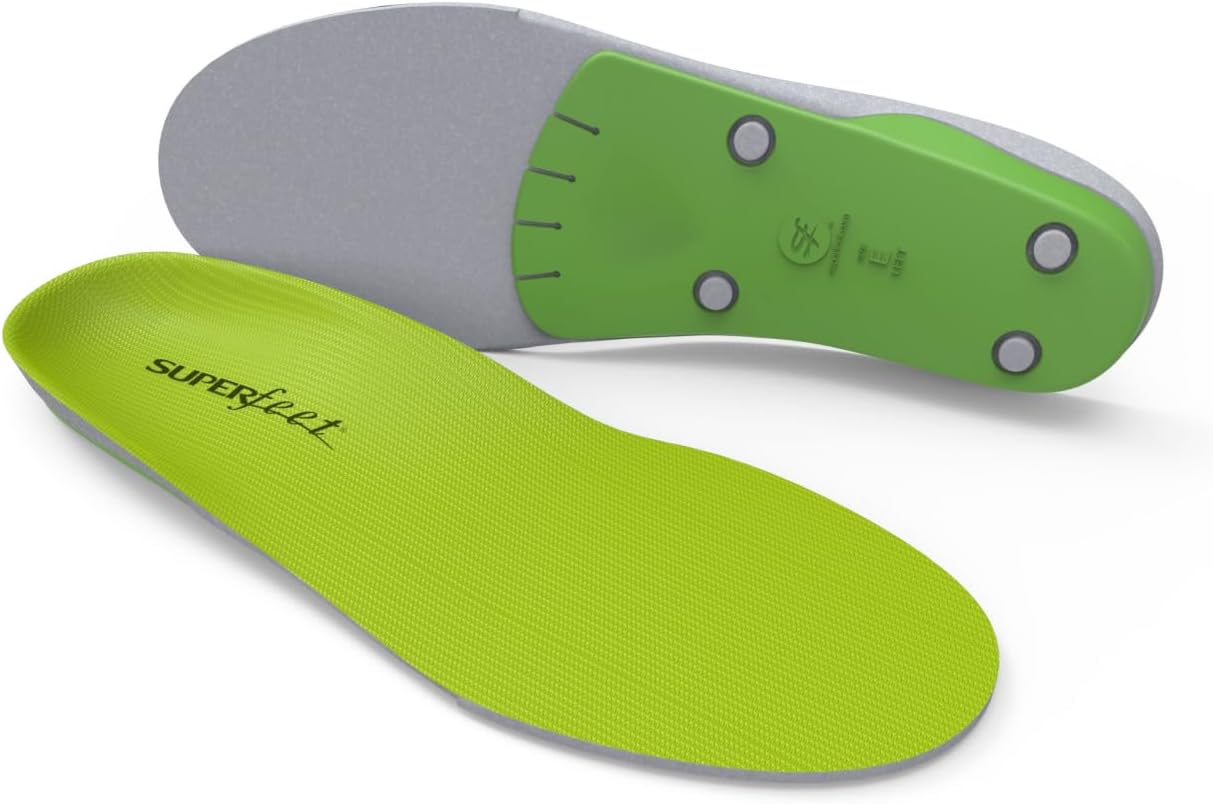
Superfeet takes the opposite approach to Dr. Scholl's: instead of cushioning, you get a firm structural shell that holds your arch and stops it flattening across a shift. For anyone whose complaint is aching arches rather than sore heels, this is the more effective design, and the difference is noticeable by the end of a long day. This particular version is cut for wide feet at 3E to 6E, which is a genuine gap in the market, since most aftermarket insoles taper in a way that squeezes a wide forefoot. The shell is the durability story too: it does not compress the way foam and gel do, so it outlasts everything else here comfortably. Two honest caveats. It is firm, and it takes a week or two to get used to if you have only worn cushioned insoles. And it needs a shoe with a removable factory insole to make room.
Pros
- Firm structural shell genuinely holds the arch all day
- Cut for wide feet, which most insoles are not
- Far more durable than foam or gel
- Over four thousand owner reviews
Cons
- Firm feel takes a week or two to adjust to
- Needs a shoe with a removable factory insole
- Most expensive option here
Best for women's work shoes
Dr. Scholl's Work All-Day Superior Comfort Insoles (Women's)
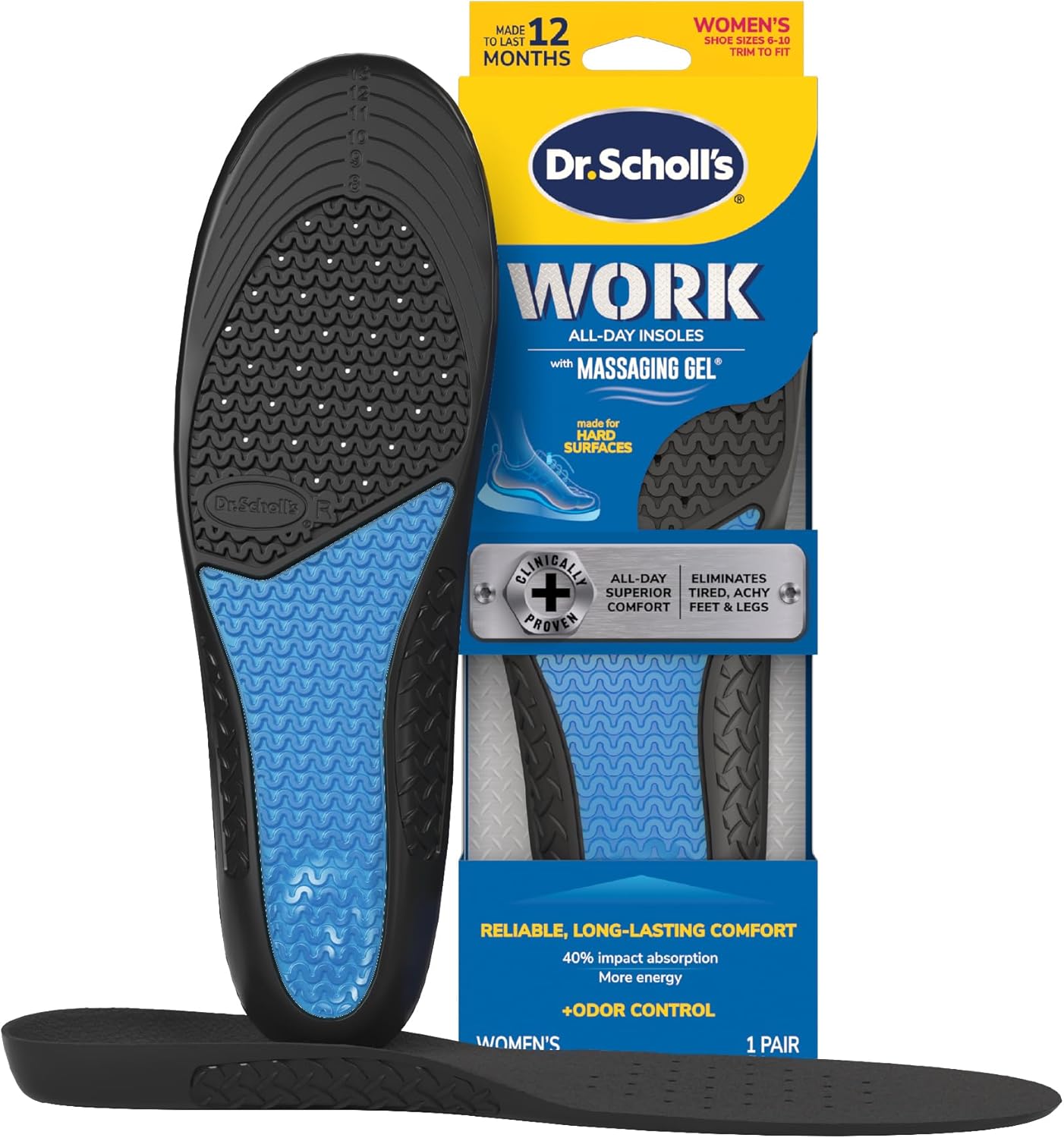
The women's version of our top pick, with the same massaging gel construction and reinforced arch support, cut and sized for women's shoes. That distinction matters more than it might sound: a men's insole trimmed down to a women's size ends up with the arch support in the wrong place, because the arch sits at a different point relative to overall length. With close to thirty thousand reviews it is nearly as well evidenced as the men's. The same trim-to-fit convenience applies, and it works in most closed work shoes, trainers and boots. The same caveat applies too: gel compresses, and on a hard floor worked full time you should plan on replacing these roughly twice a year rather than treating them as a lasting fix.
Pros
- Arch support positioned correctly for women's shoe proportions
- Close to thirty thousand owner reviews
- Trim to fit across most closed shoes
- Cheap enough to replace twice a year without thinking about it
Cons
- Gel compresses on a six month horizon
- Adds bulk to an already snug shoe
- Will not fit a clog with a fixed footbed
Best if you cover distance
Dr. Scholl's Walk Longer Insoles for Women
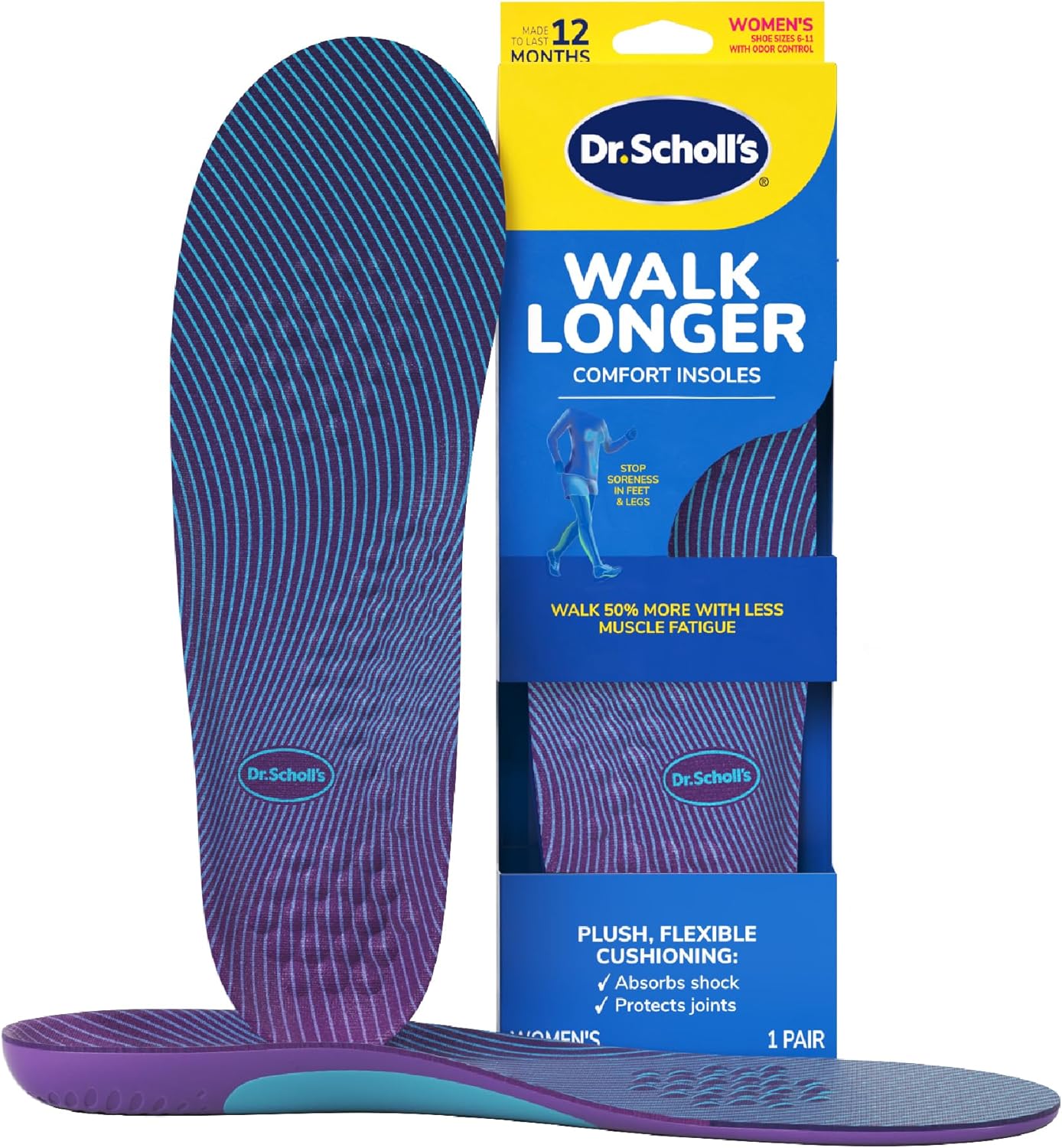
This is the pick for anyone whose shift involves walking miles rather than standing in one place, which describes a lot of ward nurses, warehouse staff and retail workers more accurately than pure standing does. The construction leans further toward plush foam cushioning than the Work All-Day, with arch support included but less emphasis on the heel gel, which suits repeated impact better than static load. With over four thousand reviews it is well evidenced for a newer product. Be clear on the distinction though: if you genuinely stand still for hours, the Work All-Day or the Superfeet will serve you better, because plush foam is exactly what collapses under sustained static load. Buy this one for movement, not for stillness.
Pros
- Plush cushioning suited to covering distance on shift
- Arch support included rather than pure foam
- Over four thousand owner reviews
Cons
- Plush foam is the wrong choice for standing still for hours
- Compresses faster than a structured insole
- Women's sizing only
Best for work boots
Timberland PRO Anti-Fatigue Technology Insole
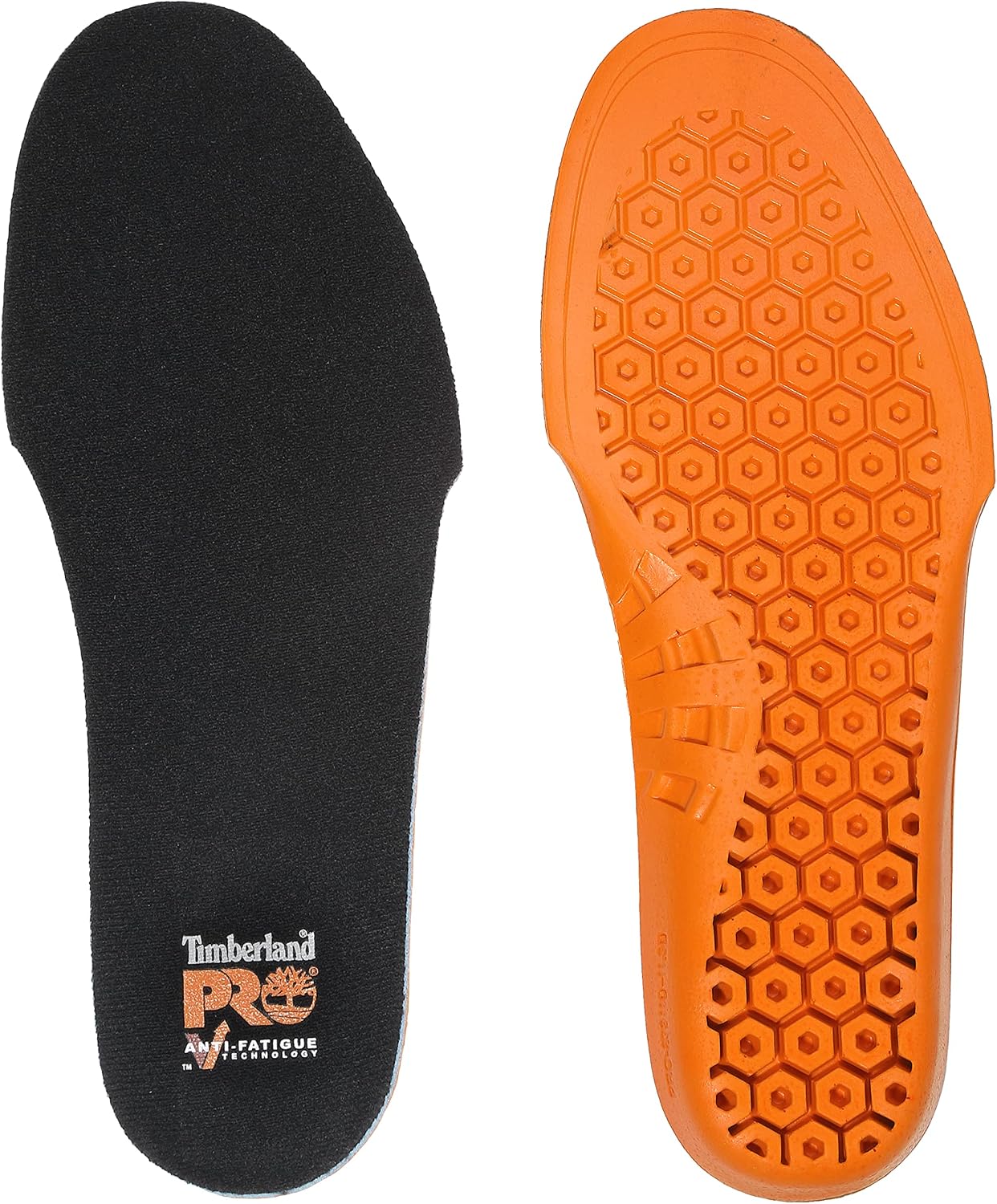
With over twenty thousand owner reviews this is the most thoroughly evidenced insole here after the Dr. Scholl's, and it is the one built specifically for the inside of a work boot rather than a trainer. The construction is the reason: an inverted-cone geometry in the heel that is meant to return energy rather than simply absorb it, under an OrthoLite top layer that handles moisture and odour, which matters more in a boot worn ten hours than in an office shoe. It is firmer than the Dr. Scholl's and more forgiving than the Superfeet, which puts it in a useful middle ground if you found one too soft and the other too rigid. The arch support is moderate rather than corrective, so it will not do the job of a proper orthotic, and the fit is trim-to-size rather than moulded.
Pros
- Over twenty thousand owner reviews
- Built for work boots specifically, not adapted from a running insole
- OrthoLite layer handles moisture and odour in enclosed footwear
- Firmness sits usefully between Dr. Scholl's and Superfeet
Cons
- Moderate arch support, not a corrective orthotic
- Bulkier than a flat factory insole, so a snug boot gets tight
- Sizing is by shoe size band rather than moulded
Also worth considering
Strong, well-reviewed products that just missed our ranked list - worth a look if the picks above aren't quite right for you.
- Dansko XP 2.0 Clog - The honest alternative to buying an insole. Dansko builds its contoured footbed into the shoe and generally will not accept an aftermarket insert, so if you are shopping for support this is the other route to it.
- Orthofeet Coral Orthopedic Women's Sneakers - Ships with a removable orthotic insole already fitted, plus spacers to adjust arch height. Worth considering if you were about to buy a shoe and an insole separately.
- ComfiLife Anti Fatigue Floor Mat - If you stand in roughly one place, a mat does more per pound than any insole and never compresses inside your shoe. The two are complementary rather than alternatives.
Frequently asked questions
Do insoles actually help if you stand all day?
They help with two specific things: redistributing pressure away from the heel and forefoot, and supporting the arch so it does not flatten and fatigue over a long shift. What they cannot do is fix a shoe that is the wrong shape or has a collapsed midsole. An insole in a worn out shoe is a patch, not a repair.
Gel or firm arch support: which is better for standing?
Firm structured support generally does more for standing all day, because it holds the arch and stops it collapsing across a shift. Gel is better at absorbing impact, which matters more for walking and running than for standing. If your arches ache, go structured. If your heels ache on hard floors, gel or a hybrid helps more.
Will insoles fit in work boots and clogs?
Trim-to-fit insoles like Dr. Scholl's fit most closed shoes and work boots once trimmed to the printed guide. Pre-moulded orthotic insoles like Superfeet are sized rather than trimmed and need a shoe with a removable factory insole to make room. Clogs with a fixed contoured footbed, such as Dansko, generally will not take an aftermarket insole at all.
How often should I replace insoles?
Every six months for someone standing full time, sooner if you are heavier or working on concrete. Foam and gel both compress permanently, and the failure is gradual so you rarely notice the day it stops working. If your feet start hurting earlier in the shift than they used to, the insole is done.
Insoles, shoes or a mat: what should I buy first?
If your shoes are more than a year old and you stand full time, replace the shoes first, because an insole cannot fix a collapsed midsole. If the shoes are decent but your arches ache, an insole is the cheapest meaningful upgrade. If you stay in one spot on a hard floor, an anti-fatigue mat outperforms both for the money.